


What's Happening?
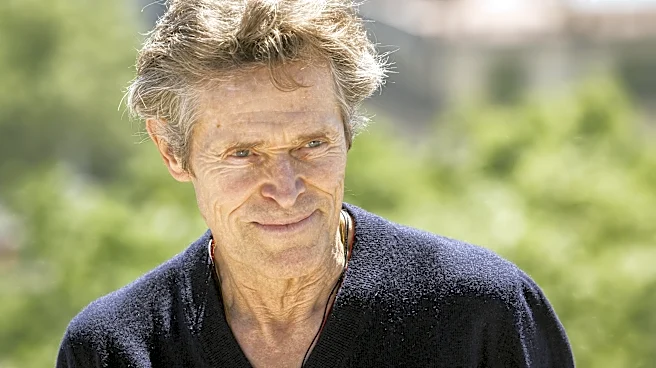
Willem Dafoe's performance as Eric 'Rick' Masters in the 1985 film 'To Live and Die in L.A.' is being recognized as his most terrifying villainous portrayal, even surpassing his iconic role as the Green Goblin in 'Spider-Man.' Directed by William Friedkin,
the film features Dafoe as a notorious counterfeiter pursued by two Secret Service agents, one of whom, Jim Hart, is killed by Masters. This act fuels the other agent, Richard Chance, to relentlessly pursue Masters. According to ComicBook.com, Dafoe's portrayal of Masters is characterized by a cool, calm, and collected demeanor, making his evil actions all the more chilling. The article suggests that this role demonstrates a level of villainy where Dafoe 'held back' in his later Marvel performance, highlighting Masters as a character who is always in control and willing to commit extreme acts, including killing law enforcement and betraying partners, to secure his position.
Why It's Important?
This re-evaluation of Willem Dafoe's early work underscores the depth and range of his acting career, particularly in villainous roles. For film enthusiasts and critics, it provides a fresh perspective on his filmography, suggesting that some of his less mainstream performances hold significant artistic merit and impact. The comparison to his Green Goblin role, a widely recognized and celebrated supervillain, elevates 'To Live and Die in L.A.' within the discourse of cinematic antagonists. It highlights how a character's psychological complexity and calculated evil, as portrayed by Dafoe, can be more unsettling than overt madness. This recognition could lead to renewed interest in the 1985 film, potentially introducing it to new audiences who are familiar with Dafoe primarily through his more recent blockbusters, thereby enriching their understanding of his artistic contributions.
What's Next?
The renewed attention on 'To Live and Die in L.A.' could lead to increased viewership and critical discussion of the film, especially among fans of Willem Dafoe and crime thrillers. This might prompt streaming platforms or film distributors to highlight the movie, potentially through special features or curated collections focusing on Dafoe's career. For Dafoe himself, this recognition reinforces his reputation as a versatile actor capable of delivering profoundly impactful performances across various genres. It could also influence future casting decisions, encouraging directors to consider him for roles that delve into complex, psychologically intense villainy, rather than solely relying on his established blockbuster persona. The discussion also opens avenues for academic and critical analysis of the evolution of villain archetypes in cinema and Dafoe's unique contribution to them.
Beyond the Headlines
The discussion around Willem Dafoe's performance in 'To Live and Die in L.A.' touches upon the broader theme of an actor's legacy and how early, perhaps less commercially successful, roles can be re-evaluated over time. It highlights the distinction between a character's overt villainy and a more subtle, chilling portrayal of evil. Masters, unlike the more sympathetic Norman Osborn, is depicted as a character fully in control of his malevolence, raising questions about the nature of evil in storytelling. This analysis encourages audiences to look beyond surface-level interpretations of characters and appreciate the nuanced craft of acting. It also implicitly critiques the tendency to define an actor solely by their most popular roles, advocating for a deeper exploration of their entire body of work to understand their artistic journey and impact on cinema.