







What's Happening?
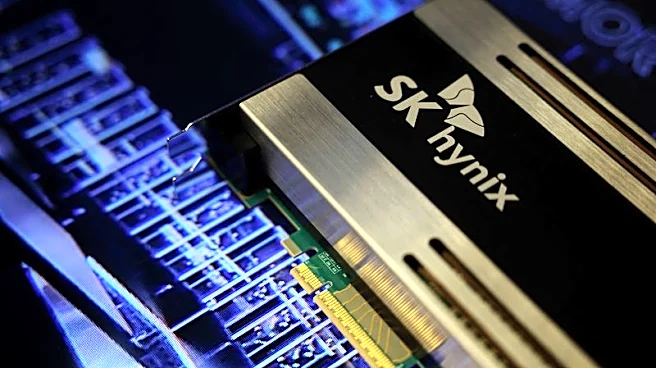
SK Hynix, a leading South Korean memory chip manufacturer, has successfully raised $26.5 billion through its initial public offering (IPO) in the United States. The company debuted on the Nasdaq with its American depositary receipts (ADRs) priced at $149
each, which opened at $170, marking a 14% increase. This IPO is the largest ever by a foreign company in the U.S. The surge in demand for SK Hynix's memory chips is largely driven by the global expansion of artificial intelligence (AI) technologies, which require high-bandwidth memory (HBM) for efficient processing. SK Hynix holds a dominant position in the HBM market, capturing 56.4% of the market share. The company plans to expand its production capabilities, including building its first U.S. production facility in Indiana.
Why It's Important?
The successful IPO of SK Hynix highlights the growing importance of memory chips in the AI sector, which is rapidly expanding. The funds raised will enable SK Hynix to enhance its production capacity to meet the increasing global demand for memory chips. This development is significant for the U.S. market as it provides American investors with easier access to invest in a major player in the semiconductor industry. The expansion of SK Hynix's operations in the U.S. could also lead to job creation and further technological advancements in the semiconductor sector. However, the memory chip industry is known for its cyclical nature, and there are concerns about potential supply-demand imbalances in the future.
What's Next?
SK Hynix's entry into the U.S. market is expected to intensify competition among major memory chip manufacturers, including Micron and Samsung. The company plans to leverage the funds raised to expand its production facilities and strengthen its position in the global market. As AI technologies continue to evolve, the demand for high-performance memory chips is likely to increase, providing growth opportunities for SK Hynix. However, the company must navigate the challenges of the cyclical nature of the memory chip industry and potential fluctuations in demand.