

What's Happening?
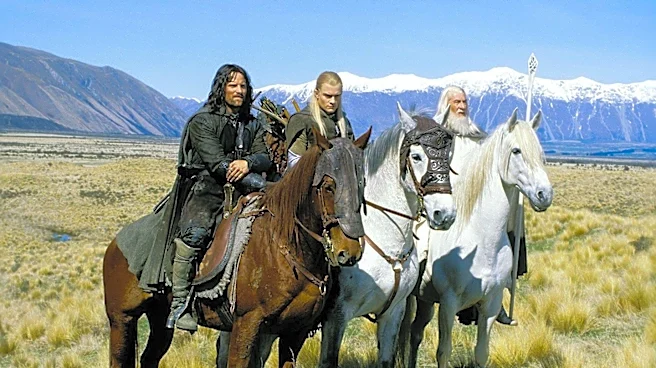
The true age of Gandalf, a central character in J.R.R. Tolkien's 'The Lord of the Rings,' is a subject of discussion, particularly contrasting his cinematic portrayal with the original literary sources. In Peter Jackson's film 'The Two Towers,' Gandalf states
he has 'walked this earth 300 lives of Men,' suggesting a specific longevity. However, this line does not originate from Tolkien's books. According to the appendices of 'The Return of the King,' the Istari, or Wizards, including Gandalf, appeared in Middle-earth approximately 1,000 years after the first shadow fell on Greenwood the Great. Given that 'The Lord of the Rings' is primarily set in 3019 of the Third Age, this places Gandalf's physical presence in Middle-earth at around 2,000 years old during the events of the trilogy, and roughly 80 years younger during 'The Hobbit.' Beyond his physical form, Tolkien's 'Unfinished Tales' and 'The Silmarillion' reveal that Gandalf, originally named Olórin, is one of the Maiar, an incarnate spirit older than Middle-earth itself, predating time.
Why It's Important?
Understanding Gandalf's true age and nature is crucial for fans and scholars of Tolkien's legendarium, as it deepens the appreciation of the character's wisdom, power, and purpose within the narrative. The discrepancy between the film's dialogue and the books highlights how adaptations can sometimes simplify or alter complex lore, potentially leading to misconceptions about the source material. Recognizing Gandalf as an ancient, immortal spirit rather than merely a long-lived man underscores the profound spiritual and cosmic dimensions of Tolkien's world. This distinction emphasizes that the Wizards are not merely powerful individuals but emissaries sent to Middle-earth to combat evil, embodying a higher, divine purpose. This deeper understanding enriches the themes of good versus evil, fate, and the enduring struggle against corruption that are central to 'The Lord of the Rings,' providing a more complete picture of the forces at play in Middle-earth.
What's Next?
The ongoing exploration and adaptation of Tolkien's works, such as the television series 'The Rings of Power,' will likely continue to prompt discussions and interpretations of established lore, including character origins and timelines. Future adaptations may choose to adhere more strictly to Tolkien's detailed appendices and supplementary texts, or they might take creative liberties, potentially sparking further debate among fans regarding canonical accuracy. The continuous analysis of Tolkien's notes, as seen in books like 'The Nature of Middle-Earth,' will also likely uncover more insights into his unfinished concepts, potentially shedding new light on characters like Gandalf and their earlier interactions with Middle-earth. This ongoing scholarly and popular engagement ensures that the nuances of Tolkien's creation, including the intricate history of its characters, remain a vibrant area of study and appreciation.
Beyond the Headlines
The discussion surrounding Gandalf's age extends beyond mere chronological facts, touching upon the philosophical and theological underpinnings of Tolkien's creation. Gandalf's existence as an immortal spirit, older than the world itself, reflects Tolkien's deep Catholic faith and his construction of a mythos that mirrors Christian cosmology, with divine beings participating in the creation and governance of the world. This aspect elevates Gandalf from a powerful wizard to a figure of divine intervention, a messenger from a higher power. The concept of an immortal soul temporarily housed in a mortal form also explores themes of sacrifice, humility, and the burden of responsibility, as Gandalf, despite his immense power, is constrained by his incarnate form and forbidden from directly dominating the free peoples of Middle-earth. This ethical framework is a cornerstone of Tolkien's storytelling, emphasizing moral choice and the importance of aiding rather than controlling sentient beings.