






What's Happening?
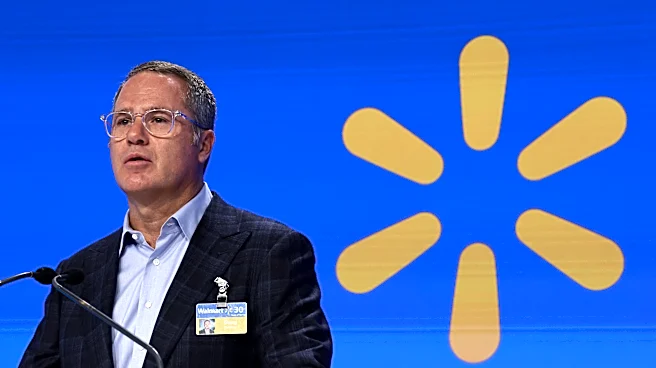
Doug McMillon, a prominent American business executive, concluded his tenure as President and Chief Executive Officer of Walmart Inc. on January 31, 2026. McMillon, who began his career at Walmart in 1984 as an hourly associate, ascended through various
leadership roles, including responsibilities at Sam’s Club and Walmart International, before becoming CEO in February 2014. During his leadership, he spearheaded Walmart's transformation into a technology-enabled omnichannel retailer, focusing on expanding e-commerce capabilities, improving delivery services, and investing in digital operations while maintaining its physical retail network. His strategic emphasis also included employee development, competitive pricing, and enhancing customer experience. John Furner succeeded McMillon as Walmart’s President and CEO on February 1, 2026.
Why It's Important?
The transition of leadership at Walmart, a major American corporation, signifies a pivotal moment for the retail industry and its stakeholders. McMillon's departure marks the end of an era characterized by significant digital transformation and adaptation to evolving consumer behaviors. His focus on integrating online and in-store experiences, alongside investments in technology and supply chain improvements, has set a precedent for how traditional retailers can compete in a rapidly changing market. The new leadership under John Furner will likely continue to navigate challenges such as intense competition from online marketplaces, evolving consumer demands, and the need for continuous technological innovation. This leadership change will influence Walmart's strategic direction, potentially impacting its vast workforce, supplier network, and millions of customers across the U.S. and internationally, as well as setting trends for the broader retail sector.
What's Next?
Following John Furner's assumption of the CEO role on February 1, 2026, Walmart is expected to continue its strategic initiatives in digital commerce, supply chain optimization, and customer experience. Furner's leadership will likely focus on building upon the foundation laid by McMillon, further integrating technology to enhance operational efficiency and customer engagement. The company will need to address ongoing challenges in the retail landscape, including managing inflation, adapting to shifts in consumer spending habits, and maintaining a competitive edge against both traditional and online rivals. Stakeholders, including investors, employees, and consumers, will closely watch Furner's initial strategic decisions and their impact on Walmart's market position and financial performance. The transition also highlights the importance of long-term succession planning in large corporations to ensure continuity and sustained growth.
Beyond the Headlines
The leadership transition at Walmart extends beyond immediate business operations, reflecting broader trends in corporate governance and the evolution of the retail sector. McMillon's career, spanning over four decades from an hourly associate to CEO, exemplifies a traditional path of internal progression and deep organizational knowledge, a model that is increasingly rare in today's fast-paced corporate environment. His emphasis on employee development and competitive pricing also touches upon the social responsibility aspect of large corporations, influencing labor practices and consumer affordability. The shift to Furner's leadership will test the resilience of Walmart's established strategies and its ability to innovate while maintaining its core values. This change underscores the continuous need for adaptability and forward-thinking leadership in navigating complex market dynamics and societal expectations for major U.S. businesses.