







What's Happening?
Arkansas Governor Sarah Huckabee Sanders has commented on Buc-ee's founder and CEO Arch "Beaver" Aplin III's remarks regarding the company's expansion strategy. Aplin indicated that Buc-ee's prioritizes "conservative, business-friendly states" over "blue
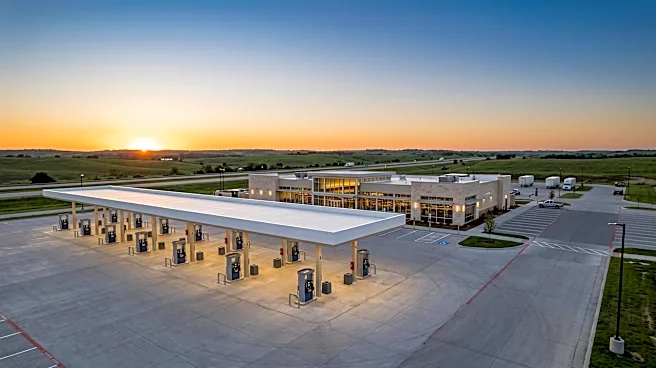
states" for new locations. This statement was made as Buc-ee's opened a new location in Benton, Arkansas. Governor Sanders shared Aplin's sentiments, stating that "red states like Arkansas are surging and people and businesses are fleeing blue states." While Buc-ee's has expanded to 13 states, only one, Colorado, is considered a solidly blue state, suggesting a deliberate pattern in their growth. Aplin emphasized that a business-friendly environment, trickling down from state leadership, makes a significant difference in their decision-making process.
Why It's Important?
Governor Sanders' comments and Buc-ee's stated expansion strategy highlight a growing trend of businesses considering political and ideological alignment when making investment decisions. This approach could significantly impact economic development and job creation in various U.S. states. States perceived as 'business-friendly' due to conservative policies, such as lower taxes, reduced regulations, or specific labor laws, may attract more corporate investment, leading to increased employment opportunities and economic growth in those regions. Conversely, states with different political leanings might face challenges in attracting or retaining businesses, potentially affecting their tax base and overall economic vitality. This dynamic could exacerbate economic disparities between states and influence migration patterns of both businesses and individuals seeking favorable environments.
What's Next?
The trend of businesses prioritizing states based on political and economic alignment is likely to continue, potentially influencing state-level policy debates. Governors and state legislatures in both 'red' and 'blue' states may increasingly tailor their economic development strategies to either attract or retain businesses, depending on their political leanings. This could lead to further competition among states to offer incentives or create regulatory environments perceived as favorable to specific industries or corporate philosophies. Businesses, in turn, might continue to publicly articulate their preferences, further solidifying this trend. The long-term implications could include shifts in regional economic power and demographic changes as both companies and individuals 'vote with their feet' for states that align with their values and economic interests.
Beyond the Headlines
The discussion around businesses favoring 'red states' over 'blue states' delves into the broader cultural and political polarization within the United States. It suggests that economic decisions are increasingly intertwined with ideological stances, moving beyond purely financial considerations. This phenomenon could lead to a more fragmented national economy, where different regions develop distinct economic profiles based on their political environments. It also raises questions about the role of corporate leadership in political discourse and the potential for businesses to become active participants in shaping state-level politics through their investment choices. The narrative of 'fleeing blue states' also touches upon demographic shifts and the perceived quality of life in different political climates, reflecting deeper societal divisions that extend beyond economic metrics.