






What's Happening?
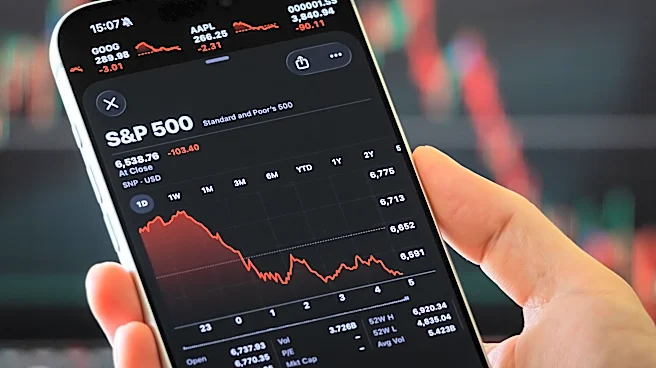
The S&P 500 experienced an 8.6% decline last week, marking its most significant weekly drop since April 2025, as the artificial intelligence (AI) trade continued to unravel. This substantial loss pushed the benchmark U.S. equities index into a correction,
defined as a 10% to 19.9% decline from its peak. The index closed at 6,910.39 on Friday, representing an 11.6% decrease from its record close on October 6. Technical analysis suggests that more losses could be ahead, with the index having fallen below a critical stack of support levels, including the psychological 7,000 mark. Key support levels are identified at 6,900.46 and potentially near 6,800, which if breached, could lead to a 13.0% drop from its record close.
Why It's Important?
The S&P 500's entry into a correction phase and the potential for further declines signal a period of heightened risk for U.S. investors. The unwinding of the AI trade, which has been a major growth engine, indicates a shift in market sentiment and could lead to broader economic implications. A sustained downturn could impact investment funds, retirement savings, and corporate valuations across various sectors. The breach of significant technical support levels suggests that investor confidence is weakening, potentially leading to a self-reinforcing cycle of selling. This situation could prompt a re-evaluation of investment strategies, with a focus on risk management and diversification as market volatility increases.
What's Next?
Technical analysts will be closely watching key support levels, particularly 6,900.46 and 6,800, to gauge the potential for further downside. A break below 6,800 could indicate a more significant decline, potentially reaching the 6,677.43 to 6,643.82 area, or even the April 8 gap at 6,618.26. While markets rarely move in a straight line and temporary bounces are possible, any rebound would likely face resistance at former support levels, such as 7,002.28, 7,080, and the 7,237 to 7,314 area. A sustained recovery would require the index to move above its 200-day moving average, near 7,350. The market's direction will largely depend on whether investor sentiment stabilizes and if the AI sector can find a new footing.
Beyond the Headlines
The current market dynamics highlight the inherent risks associated with concentrated market leadership, where a few sectors or stocks drive a significant portion of overall market gains. The rapid reversal in the AI trade underscores the potential for swift and substantial corrections when investor sentiment shifts, particularly in areas perceived as speculative. This situation could lead to a broader re-evaluation of growth versus value investing, as investors seek more stable returns in a volatile environment. The reliance on technical analysis in such periods also emphasizes the psychological aspects of market behavior, where key price levels can act as self-fulfilling prophecies for traders. The current correction may serve as a reminder of the importance of fundamental analysis and long-term investment horizons, rather than chasing short-term trends.