






What's Happening?
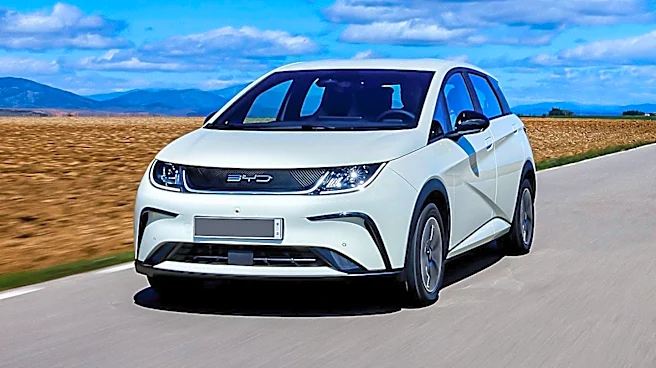
Sales of Chinese hybrid cars in the European Union have significantly increased since the implementation of countervailing duties on fully electric vehicles from China in 2024. Eurostat data, as reported by The Guardian, indicates a substantial rise in both
full and plug-in hybrid sales. In 2022, only 659 Chinese-made full hybrids were sold in the EU, a number that surged to 160,662 in the first seven months of the current year. Similarly, plug-in hybrid sales jumped from 56,706 in all of 2022 to 217,764 from January to July. This boom is attributed to a 'tariff loophole,' as the EU's duties of up to 45 percent apply only to fully electric cars, leaving hybrids subject to the standard 10 percent rate. Chinese automakers, already proficient in hybrid technology due to their home market, have swiftly adapted by increasing shipments of these vehicles to Europe. Hybrid vehicles now constitute almost 37 percent of the EU car market, while fully electric cars account for just over 21 percent, according to the European Automobile Manufacturers’ Association (ACEA).
Why It's Important?
The surge in Chinese hybrid car sales in the EU has significant implications for the global automotive industry and trade relations. For the EU, it highlights a potential flaw in its tariff strategy aimed at protecting its domestic EV market from what it considers unfair competition due to Chinese state subsidies. The unexpected shift to hybrids by Chinese manufacturers means that the intended economic protection for European automakers is being circumvented, leading to continued market penetration by Chinese brands. This development could also impact the EU's climate goals, as studies by the International Council on Clean Transportation suggest that plug-in hybrids often emit significantly more CO2 in real-world use than their official figures, primarily because many drivers do not consistently charge them. The situation also underscores the agility of Chinese manufacturers in adapting to trade policies, posing a challenge for policymakers attempting to balance trade protection with environmental objectives. The German Association of the Automotive Industry (VDA), which previously cautioned against tariffs, is now considering the use of WTO-compliant trade defense instruments for Chinese hybrids, indicating a shift in industry sentiment.
What's Next?
The European Commission is actively addressing the influx of Chinese hybrids, having requested China to voluntarily reduce its hybrid exports. Should China not comply, the EU is likely to implement safeguards, most probably in the form of quotas, to curb these imports. This potential action signals a more aggressive stance from Brussels to close the 'tariff loophole' and protect its automotive industry. A meeting between EU trade commissioner Maroš Šefčovič and his Chinese counterpart, Wang Wentao, is scheduled for early October to discuss a potential truce. The outcome of these negotiations will determine the immediate future of Chinese hybrid car imports into the EU. Furthermore, the German Association of the Automotive Industry (VDA) has indicated a willingness to consider tariffs specifically on Chinese hybrids where unfair conduct is proven, suggesting a united front among European stakeholders to address the issue. This could lead to a broader application of tariffs or other trade defense measures against Chinese hybrid vehicles.
Beyond the Headlines
The rapid increase in Chinese hybrid car sales in the EU, despite tariffs on fully electric vehicles, reveals a deeper challenge in global trade policy and the transition to green technologies. It highlights the complexity of implementing targeted trade measures in a dynamic market, where manufacturers can quickly adapt their product offerings to exploit policy gaps. This situation could lead to a re-evaluation of how 'green' technologies are defined and regulated in trade agreements, especially concerning hybrid vehicles that offer a partial, rather than full, transition away from fossil fuels. The EU's trade deficit with China, which stands at €1.18 billion per day, adds a significant economic dimension to this issue, making it a critical point of contention in broader EU-China relations. The ethical implications of promoting hybrid technology as a 'green' solution, while studies suggest higher real-world emissions, also warrant scrutiny, potentially influencing future environmental regulations and consumer perceptions of sustainable transportation.