
What's Happening?
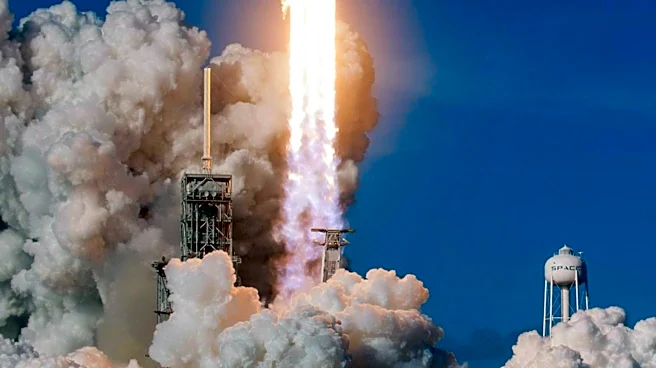
SpaceX's Falcon Heavy rocket successfully completed its first commercial mission on Thursday, April 11, 2019, launching from Kennedy Space Center in Florida. The rocket carried a communications satellite
for Arabsat, a Saudi-based telecommunications company. This mission marked a significant milestone for Falcon Heavy, as its previous flight in 2018 was a demonstration carrying Elon Musk's Tesla Roadster. The commercial flight validated the rocket's capability to deliver paying customer payloads. Reuters described Falcon Heavy as the most potent operational rocket globally at the time, with launch commentary noting it produced 5.1 million pounds of thrust at 33 seconds into flight. The launch was initially delayed due to high-altitude winds but proceeded successfully on the rescheduled date. SpaceX also planned to land the Falcon Heavy's side boosters at Landing Zones 1 and 2, and the center core on the 'Of Course I Still Love You' droneship, highlighting the company's commitment to reusability.
Why It's Important?
The successful commercial launch of Falcon Heavy in 2019 was crucial for SpaceX and the broader space industry. It transformed the Falcon Heavy from a demonstration vehicle into a viable commercial product, proving its ability to meet the demands of paying customers. This event signaled to established launch providers that SpaceX was a serious competitor in the heavy-lift market, capable of offering reliable and powerful launch services. For customers like Arabsat, choosing a rocket on only its second flight demonstrated a willingness to accept risk in exchange for significant capacity and schedule benefits. The mission also reinforced the economic viability of reusable rocket technology, as SpaceX's recovery plan for the boosters aimed to reduce operational costs. This success contributed to a more competitive launch market, encouraging other providers to innovate and adapt to evolving customer needs for heavy-lift capabilities.
What's Next?
While the original event occurred in 2019, its implications continue to shape the heavy-lift launch market. Falcon Heavy maintains its niche as a proven and reliable option, appealing to operators who prioritize a flight record over raw thrust, especially as newer vehicles like Starship continue their testing phases. The competitive landscape has evolved significantly since 2019, with new entrants like Blue Origin's New Glenn and United Launch Alliance's Vulcan entering the fray. This increased competition is pushing customers towards diversified launch strategies, often utilizing multiple providers to mitigate risks and ensure schedule adherence. The demand for heavy-lift capabilities is also expected to grow, driven by emerging needs such as orbital data centers and large satellite constellations, which will further intensify competition and innovation in the sector.
Beyond the Headlines
The Falcon Heavy's first commercial flight underscored a fundamental shift in the space launch industry: the move from government-dominated, bespoke launches to a more commercial, competitive model. SpaceX's strategy of using a modular design, combining three Falcon 9-derived first-stage cores, demonstrated a pragmatic approach to achieving heavy-lift capabilities without the extensive development costs of an entirely new rocket. This engineering philosophy, coupled with a strong emphasis on reusability, has challenged traditional aerospace manufacturing and operational paradigms. The success of such missions also has broader implications for national space policies, encouraging governments to consider commercial providers for critical missions and fostering international partnerships in space exploration and utilization. The event highlighted the growing importance of commercial space capabilities in supporting global telecommunications infrastructure and other space-based services.