







What's Happening?
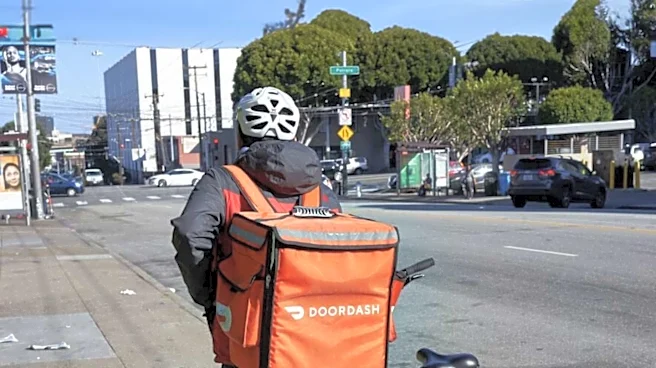
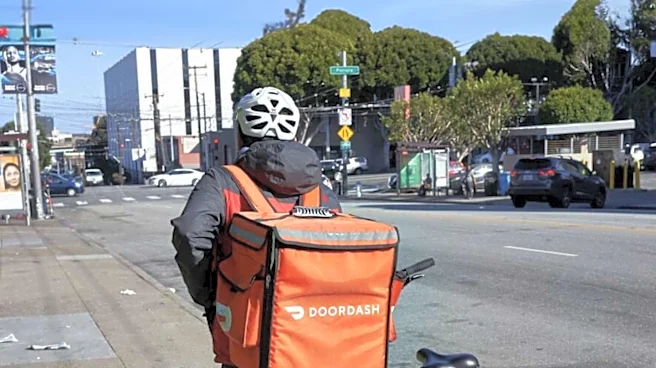
DoorDash CEO Tony Xu has reported that the company has received only 'several hundred orders in total' from personal AI assistants since their launch. This statement aligns with similar observations from other major platforms like Uber and Airbnb, indicating
a slow adoption rate for AI agents in e-commerce. Uber's CFO Balaji Krishnamurthy noted that AI agents accounted for only four rides and 500 Uber Eats deliveries out of 320 million total trips in a recent week. Airbnb CEO Brian Chesky also stated that bookings via Meta's Muse and Instinct AI agents were 'very, very low.' These figures suggest that despite the hype surrounding AI agents designed to automate tasks like booking travel or ordering food, consumer engagement remains minimal across leading service platforms. The AI agents from companies like Meta and OpenAI were launched in September, making these early reports significant indicators of initial user behavior.
Why It's Important?
The limited traction of AI agents on major platforms like DoorDash, Uber, and Airbnb suggests a potential disconnect between technological innovation and consumer readiness or perceived utility. This slow adoption could impact investment strategies in AI development for e-commerce, as companies may re-evaluate the immediate return on investment for agentic commerce solutions. For consumers, it indicates that current AI agents may not yet offer a compelling advantage over traditional app-based ordering, possibly due to concerns about trust, data privacy, or the simplicity of existing manual processes. The findings also highlight a challenge for AI developers: creating agents that solve genuine user problems rather than automating already simple tasks. This trend could lead to a shift in focus for AI development, prioritizing more complex problem-solving or enhanced user experience within existing platforms rather than relying on third-party agent adoption.
What's Next?
In response to the low adoption of third-party AI agents, companies like DoorDash, Uber, and Airbnb are focusing on integrating AI tools directly into their own platforms to enhance user experience. DoorDash is testing features like 'Ask DoorDash' for grocery list building via photos or text, and 'Text DoorDash' for order placement outside the app. Uber Eats offers 'Cart Assistance,' allowing users to upload handwritten lists for automated basket filling, which has shown to double average basket sizes. Airbnb plans to roll out its own AI agent early next year to help users plan trips and manage reservations. While these companies are developing proprietary AI solutions, they are not entirely closing the door on third-party agents, with Uber indicating ongoing discussions to negotiate terms of trade. The future will likely see a dual approach: continued internal AI innovation to improve core services and cautious exploration of partnerships with external AI agent developers.
Beyond the Headlines
The lukewarm reception of AI agents for everyday commerce tasks raises deeper questions about consumer behavior, trust in automation, and the actual value proposition of these technologies. One underlying implication is that for many routine transactions, the human element of choice, comparison, and even the 'discovery' phase (as noted by Airbnb's CEO regarding travel planning) remains a significant part of the user experience. The lack of transparency regarding how AI agents collect and use data also contributes to a trust deficit, hindering widespread adoption. This scenario suggests that the ethical and privacy considerations of AI need to be more robustly addressed for consumers to fully embrace agentic commerce. Furthermore, it highlights a potential overestimation by Silicon Valley of consumers' desire to fully delegate simple tasks, indicating that the 'problem' AI agents aim to solve might not be as pressing as perceived, or that the solutions offered are not yet sufficiently superior to existing methods.