







What's Happening?
Ørsted, the Danish offshore wind energy giant, has won a significant tax dispute with Danish tax authorities. The dispute originated in 2020 when Danish authorities claimed 6.6 billion Danish crowns (approximately $1 billion USD) in taxes on two of Ørsted's
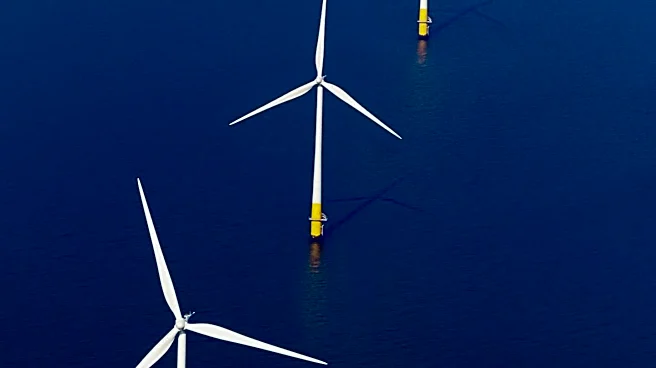
British wind farms: Walney Extension in the Irish Sea and Hornsea One in the North Sea. Ørsted contended that these projects were built, owned, and operated by its British subsidiaries and had already paid taxes in the UK. An advisory commission operating under the EU Arbitration Convention ruled in favor of Ørsted, affirming that the projects have a genuine purpose in Britain and are taxable there. This ruling is expected to result in only a minor tax adjustment in Denmark for Ørsted, largely offset by tax reductions in the UK. Ørsted anticipates that similar cases will be resolved based on the same legal principles established by this decision.
Why It's Important?
This ruling is important for Ørsted and the broader renewable energy sector, particularly for companies operating across international borders. It provides clarity and precedent regarding the taxation of multinational energy projects, reducing financial uncertainty for companies investing in large-scale infrastructure. For Ørsted, avoiding a $1 billion tax liability significantly strengthens its financial position, allowing it to reallocate resources towards further development of offshore wind projects, including those in the U.S. This decision could encourage more foreign investment in the U.S. renewable energy market by providing a more predictable international tax environment. Conversely, a loss for Ørsted could have set a precedent for double taxation, potentially deterring cross-border investments and increasing the cost of renewable energy development. The outcome underscores the complexities of international tax law and its direct impact on the economic viability and expansion of global energy companies.
What's Next?
Following this favorable ruling, Ørsted is likely to continue its aggressive expansion in the offshore wind market, both in Europe and the U.S., with greater financial certainty. The company expects similar tax cases to be resolved using the same legal principles, which could lead to further financial stability and predictability across its international operations. This precedent may also influence how other multinational energy companies structure their projects and manage their tax obligations, potentially streamlining cross-border investments in renewable energy. For the U.S. market, this could translate into increased investment from Ørsted and other international players, accelerating the development of offshore wind capacity. The ruling might also prompt a review of international tax agreements and arbitration mechanisms to ensure they adequately address the unique structures and operations of global energy projects, particularly in the context of the global push for renewable energy.
Beyond the Headlines
The tax dispute highlights a deeper issue concerning the fiscal frameworks governing multinational corporations, especially those involved in critical infrastructure development like renewable energy. The resolution through an international advisory commission underscores the importance of established arbitration conventions in resolving complex cross-border financial disagreements. This case could serve as a benchmark for how international bodies interpret the 'genuine purpose' of subsidiaries in different jurisdictions, impacting corporate structuring and tax planning for global enterprises. Furthermore, it subtly reflects the ongoing tension between national tax authorities seeking to maximize revenue and multinational corporations striving for efficient and predictable tax environments. The outcome, favoring the company, could be seen as a positive signal for the global energy transition, as it reduces financial hurdles for major developers. It also emphasizes the need for harmonized international tax policies to support global efforts in combating climate change through renewable energy deployment.