
What's Happening?
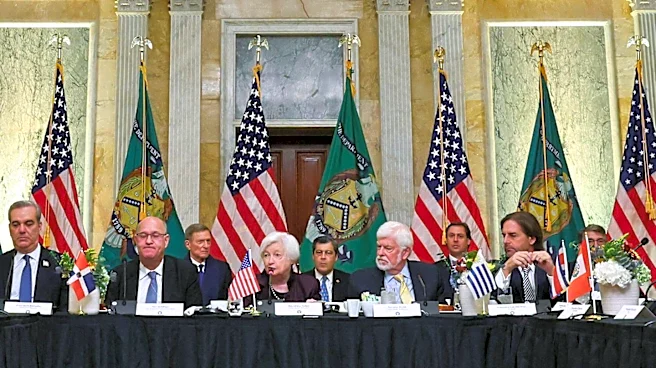
Tobias Adrian of the International Monetary Fund (IMF) participated in Ripple’s Swell Platinum Summit in New York, joining a panel discussion titled 'Accelerating Stablecoin Adoption.' The discussion also
featured Luke Boland of Standard Chartered and Ryan Lawler of Axios. The summit focused on the requirements for integrating stablecoins into everyday payments and institutional finance, emphasizing the need for regulatory clarity, trusted infrastructure, and practical solutions that balance ease of use with risk management. Caroline D. Pham, who also participated, discussed the OCC's final rule implementing the GENIUS Act, its implications for bank versus neobank stablecoin issuers, and use cases such as collateral management in global markets and correspondent banking flows. The conversation also explored stablecoins in comparison to tokenized deposits and the outlook for increased adoption and interoperability. The event aimed to foster dialogue among policymakers, financial institutions, and technology companies to advance the potential of stablecoins.
Why It's Important?
The participation of a senior IMF representative in a discussion about stablecoin adoption at a major industry summit underscores the growing recognition of digital currencies' potential impact on global finance. For the U.S., the acceleration of stablecoin adoption could revolutionize payment systems, potentially increasing efficiency and reducing transaction costs for both consumers and businesses. However, it also presents significant regulatory challenges, as highlighted by the discussion on the OCC's GENIUS Act. The debate between bank and neobank issuers, as well as the comparison with tokenized deposits, points to a complex evolving landscape that U.S. financial regulators must navigate to ensure financial stability and consumer protection. The potential for stablecoins in collateral management and correspondent banking could enhance the competitiveness of U.S. financial institutions in global markets, but also requires robust frameworks to manage associated risks. The outcome of these discussions will likely influence future U.S. policy and regulatory approaches to digital assets.
What's Next?
The discussions at Ripple's Swell Platinum Summit are expected to contribute to ongoing dialogues among policymakers, financial institutions, and technology companies regarding the future of stablecoins. The insights shared by Tobias Adrian of the IMF and other panelists will likely inform future policy considerations and regulatory frameworks for digital assets, both domestically and internationally. We can anticipate continued efforts to achieve regulatory clarity, which is crucial for fostering innovation while mitigating risks. The focus on interoperability suggests a future where different stablecoins and digital payment systems can seamlessly interact, potentially leading to a more integrated global financial ecosystem. Further research and pilot programs exploring the practical applications of stablecoins in areas like cross-border payments and institutional finance are also likely to emerge, driven by the momentum from such high-level discussions.
Beyond the Headlines
The push for stablecoin adoption, as discussed at the summit, represents a significant step towards the digitalization of finance, with profound implications for the traditional banking sector and monetary policy. The ethical considerations revolve around financial inclusion, data privacy, and the potential for increased surveillance in a fully digital currency environment. Legally, the distinction between stablecoins and tokenized deposits, and the regulatory treatment of different issuers, will shape the competitive landscape and could lead to new legal precedents. Culturally, the widespread adoption of stablecoins could alter consumer behavior regarding payments and savings, potentially accelerating a shift away from physical cash. Long-term, this development could contribute to a more efficient, but also potentially more centralized, global financial system, raising questions about decentralization and the role of central banks in a digital age. The U.S. response to these trends will be critical in shaping its future economic competitiveness and technological leadership.