



What's Happening?
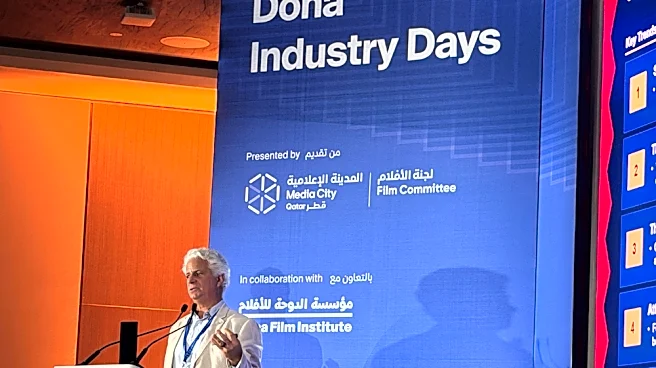
Filmmaker James Gray, during a press conference at the Doha Film Festival, shared how advice from Francis Ford Coppola profoundly shaped his career. Coppola's counsel, given in response to a fan letter Gray wrote as a teenager, was to 'Be personal. There’s
only one of you in this world.' Gray stated that he has strived to incorporate this philosophy into his filmmaking, believing that his unique voice is best expressed through personal narratives. He also expressed concern that the current film industry, both in the U.S. and internationally, often discourages directors from their individual voices, pushing them towards broader statements or genre conventions. Gray was in Doha to present the MENA premiere of his latest crime drama, 'Paper Tiger,' starring Adam Driver, Miles Teller, and Scarlett Johansson, a film deeply rooted in his own family history and set in 1980s New York.
Why It's Important?
Gray's emphasis on personal storytelling and his critique of the industry's pressure to conform to genre or broader statements highlight a significant tension within contemporary cinema. His approach, inspired by a legendary director like Coppola, advocates for authenticity and individual expression, which can lead to more unique and impactful films. This perspective is particularly relevant in an era dominated by large-scale blockbusters and franchise filmmaking, where artistic individuality can sometimes be overshadowed by commercial considerations. The success of films like 'Paper Tiger,' which draws heavily on Gray's personal experiences, demonstrates the enduring power of intimate narratives to resonate with audiences. His views also contribute to the ongoing discussion about the future of independent cinema and its ability to thrive alongside mainstream productions.
What's Next?
The ongoing discussion about the balance between artistic integrity and commercial viability in filmmaking is likely to continue, with filmmakers like James Gray advocating for personal expression. The reception of 'Paper Tiger' and other independent films that prioritize unique voices will be a key indicator of audience appetite for such content. As technology makes filmmaking more accessible, Gray expresses optimism that new voices will emerge, potentially challenging the dominance of the blockbuster model. This could lead to a more diverse cinematic landscape, with a greater variety of stories and perspectives reaching audiences. The debate over government support for cinema, as highlighted by Brazilian producer Rodrigo Teixeira's comparison between Brazil and the U.S., also suggests potential future discussions about funding models for independent film in the United States.
Beyond the Headlines
James Gray's reflections on Francis Ford Coppola's advice delve into the deeper philosophical underpinnings of artistic creation. The idea that a filmmaker's most valuable asset is their unique personal voice speaks to the essence of art itself – the translation of individual experience and perspective into a universal language. Gray's concern about the industry's tendency to suppress this individuality touches upon broader cultural implications, suggesting a potential homogenization of storytelling that could diminish the richness and diversity of cinematic expression. This struggle between personal vision and commercial pressures is not new, but it gains renewed urgency in a media landscape increasingly shaped by corporate mergers and algorithmic curation. The call for authenticity in filmmaking can be seen as a resistance against these forces, advocating for a cinema that fosters empathy and understanding by allowing audiences to connect with deeply personal narratives.