






What's Happening?
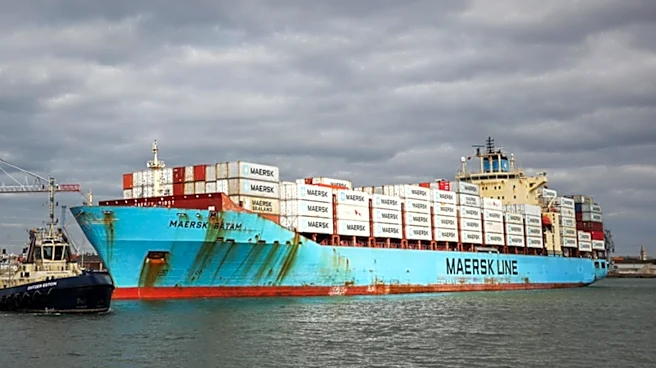
Maersk has announced a revised Peak Season Surcharge (PSS) for shipments originating from specific Indian Subcontinent locations destined for the U.S. and Canadian East Coast and Gulf. Effective November 8, 2026, the new rates are US$3,850 per applicable
container from northwest India, Nepal, and Bhutan, and US$4,200 from southern and eastern India, Sri Lanka, Bangladesh, and Maldives. This advisory, issued on November 5, excludes Houston (USHOU) from the specified destination scope and does not apply to Maersk Spot bookings. The surcharge applies to various equipment groups, including 20-foot dry and refrigerated containers, 40-foot dry and high-cube dry containers, 45-foot high-cube dry containers, and 40-foot high-cube refrigerated containers. For shipments governed by the U.S. Federal Maritime Commission (FMC), the applicable surcharge is determined by the last container gate-in date for non-Spot bookings.
Why It's Important?
This revision by Maersk directly impacts U.S. importers and exporters utilizing ocean freight services from the Indian Subcontinent. The differential of US$350 per container between the two origin groups means that businesses sourcing goods from different regions within the Indian Subcontinent will face varying additional costs. For example, a shipment of 10 eligible containers could see a US$3,500 difference in PSS depending on the origin. This necessitates a thorough re-evaluation of supply chain costs and logistics strategies for U.S. businesses. While the surcharge is only one component of the total freight quotation, it can significantly influence overall shipping expenses and potentially affect the competitiveness of goods in the U.S. market. Shippers and freight forwarders must carefully consider the origin grouping, destination, equipment type, and pricing date to accurately calculate costs and prevent misapplication of the revised rates.
What's Next?
U.S. businesses and freight forwarders involved in trade with the Indian Subcontinent will need to meticulously review their current and upcoming shipping arrangements to account for Maersk's revised PSS. This includes comparing the complete booking terms, not just the surcharge, to determine the most cost-effective routing and gateway. Exporters will also need to assess alternative routings, considering inland transport, terminal costs, ocean freight, sailing schedules, and delivery requirements, as a lower surcharge at one gateway might be offset by other logistical expenses. The distinction between FMC-governed and non-FMC shipments regarding the Price Calculation Date (PCD) will be crucial for determining the applicable surcharge, requiring careful attention to booking categories and relevant pricing dates.
Beyond the Headlines
The implementation of revised peak season surcharges by major carriers like Maersk highlights the dynamic nature of global supply chains and the ongoing challenges faced by the international ocean transportation system. Such surcharges often reflect fluctuations in demand, capacity constraints, and operational costs, which can be influenced by various factors including geopolitical events, port congestion, and fuel prices. For U.S. businesses, these adjustments underscore the importance of supply chain resilience and diversification. Relying on a single carrier or route can expose businesses to unexpected cost increases. The role of regulatory bodies like the Federal Maritime Commission (FMC) in overseeing these practices becomes critical to ensure fair and transparent pricing within the U.S. international ocean transportation system, ultimately supporting U.S. exporters, importers, and consumers.