







What's Happening?
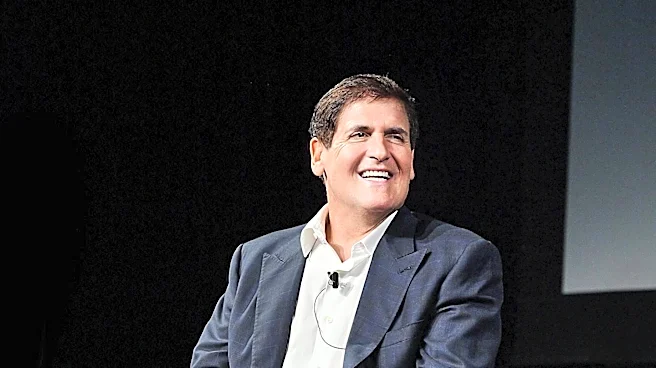
Billionaire Mark Cuban has shed light on the content creation strategy employed by popular YouTuber MrBeast (Jimmy Donaldson), stating that MrBeast invests millions of dollars into reverse-engineering algorithms across various social media platforms.
This approach allows him to generate ideas for his highly successful videos and content. Cuban shared this insight during an interview, emphasizing that MrBeast's method is not about producing a single superior message, but rather creating numerous variations to ensure content reaches diverse audiences through personalized algorithms. This strategy was highlighted in the context of political campaigning, with Cuban suggesting that future campaigns should adopt a similar data-driven approach to maximize their reach and impact. MrBeast himself has previously discussed tracking viewer engagement metrics, such as where viewers stop watching, to refine his video content and maximize retention.
Why It's Important?
This revelation underscores a significant shift in content creation and digital marketing, moving from purely creative endeavors to a highly analytical and data-driven process. For U.S. industries, particularly media, advertising, and political campaigns, MrBeast's strategy, as described by Cuban, presents a powerful model for audience engagement and message dissemination. It suggests that success in the digital age increasingly relies on understanding and manipulating algorithmic behavior rather than solely on the intrinsic quality of the content. This could lead to increased investment in data analytics and algorithm research within companies and organizations aiming to capture public attention. The implications extend to how information, including political messaging, is consumed and processed, potentially influencing public opinion and electoral outcomes by optimizing content for algorithmic distribution.
What's Next?
The insights into MrBeast's algorithmic approach could prompt a re-evaluation of content strategies across various sectors. Political campaigns, as suggested by Cuban, may increasingly invest in data scientists and engineers to 'reverse-engineer' social media algorithms, leading to more targeted and pervasive messaging. This could escalate the 'arms race' for algorithmic dominance, where organizations compete to understand and leverage platform mechanics for their benefit. Businesses and media companies might also adopt similar models, focusing on granular data analysis to optimize content for maximum reach and engagement. This trend could lead to a greater emphasis on A/B testing, audience retention metrics, and the continuous adaptation of content based on algorithmic feedback, potentially reshaping the landscape of digital communication and influence.
Beyond the Headlines
The strategic use of algorithmic reverse-engineering raises deeper questions about the nature of digital influence and the future of information consumption. If content success is increasingly determined by algorithmic compatibility rather than inherent merit, it could lead to a homogenization of popular content, as creators converge on what algorithms favor. This approach also highlights ethical considerations regarding transparency and manipulation. When algorithms are 'filtered forward' rather than 'filtered out,' as Cuban noted, it implies a system designed to reinforce existing interests, potentially creating echo chambers and limiting exposure to diverse viewpoints. The long-term societal impact could include a more fragmented information landscape, where individuals are primarily exposed to content tailored to their perceived preferences, potentially exacerbating polarization and making it harder for novel or challenging ideas to gain traction without significant algorithmic investment.