




What's Happening?
New Jersey's ambitious plans for widespread electric vehicle (EV) adoption are encountering challenges due to heightened federal enforcement of the Uyghur Forced Labor Prevention Act (UFLPA). This federal law creates a presumption that goods produced
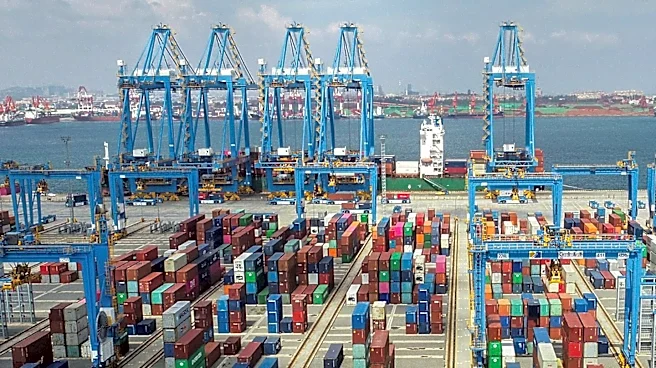
in China's Xinjiang region are made with forced labor, requiring importers to prove otherwise. U.S. Customs and Border Protection (CBP) has already detained thousands of shipments, including critical components for batteries, solar panels, and automotive parts. A proposed bill in the New Jersey Legislature, Assembly Bill 5327, aims to prohibit state agencies, local governments, public schools, and colleges from purchasing EVs unless manufacturers certify that no forced or child labor was used in their production, covering the entire supply chain from raw materials to finished vehicles. This legislation would impose civil penalties for false certifications, either $10,000 per false statement or 50% of the total contract value, whichever is greater.
Why It's Important?
The increased federal scrutiny and potential state-level restrictions pose a significant hurdle for New Jersey's clean energy goals. The state's EV strategy relies heavily on a consistent supply of electric vehicles and battery components, and China currently dominates the global processing of many critical minerals used in EV batteries, such as lithium, graphite, and rare earth materials. Concerns about forced labor in Xinjiang's supply chains could lead to import restrictions, shipment detentions, and increased costs, potentially affecting the availability and affordability of EVs in New Jersey. While automakers are investing in diversifying their supply chains, fully relocating these operations is a long-term endeavor. This situation highlights the growing tension between environmental policy, global trade, and human rights, forcing policymakers to balance clean energy objectives with ethical sourcing and compliance with federal import regulations.
What's Next?
If Assembly Bill 5327 progresses, New Jersey state agencies will face additional procurement requirements, necessitating extensive documentation from EV manufacturers regarding their supply chains. This could compel manufacturers to further investigate and certify the labor practices involved in every stage of their production. Federal enforcement of the UFLPA is expected to continue, leading to ongoing scrutiny of EV battery supply chains and potential disruptions for importers unable to provide sufficient evidence of forced labor-free production. Automakers will likely intensify their efforts to establish alternative supply chains outside China, focusing on domestic manufacturing and sourcing critical minerals from other countries. The debate will continue to evolve as policymakers grapple with ensuring that clean energy transitions are achieved through supply chains that adhere to human rights standards and evolving federal import restrictions.
Beyond the Headlines
The intersection of New Jersey's EV push and federal forced labor laws reveals a broader national challenge in balancing economic goals with ethical imperatives. The UFLPA's enforcement reflects a growing global demand for corporate accountability and transparency in supply chains. For U.S. consumers, this could mean higher prices for EVs or a slower rollout of electric vehicle infrastructure if supply chain disruptions become widespread. It also encourages a re-evaluation of trade relationships and a push towards more resilient, ethically sourced domestic or allied supply chains. The situation in New Jersey could serve as a microcosm for other states pursuing aggressive clean energy agendas, demonstrating the complexities of achieving these goals while adhering to human rights standards and navigating geopolitical trade tensions. This also puts pressure on the tech and automotive industries to innovate not just in product development, but also in establishing verifiable, ethical sourcing practices.