







What's Happening?
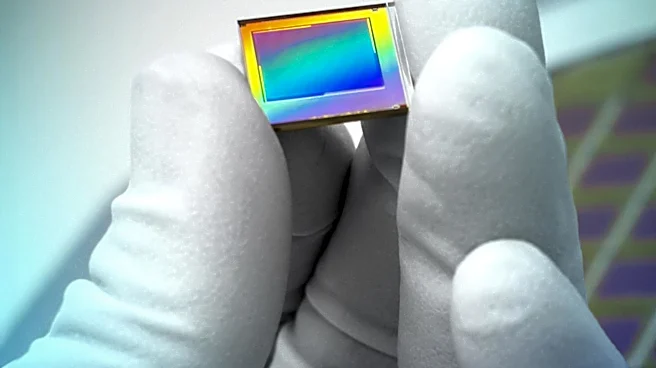
Recent advancements in photonic accelerometer technology have been highlighted in a study focusing on the integration of monolithic photonic accelerometers with on-chip fringe-counting capabilities. This technology leverages optical displacement sensing,
which offers high sensitivity and immunity to electromagnetic interference, making it a promising alternative to traditional capacitive or piezoelectric transduction methods. The study details the design and simulation of a photonic accelerometer that uses silicon-nitride cantilevers to detect input acceleration. The deflection of these cantilevers alters the optical path length and refractive index, which is then measured using Mach–Zehnder interferometers (MZIs). This approach allows for precise measurement of acceleration by detecting changes in optical phase shifts. The research underscores the potential for these sensors to achieve high sensitivity and commercial viability, with applications in various fields requiring precise inertial measurements.
Why It's Important?
The development of photonic accelerometers represents a significant advancement in sensor technology, with potential implications for industries reliant on precise motion detection, such as aerospace, automotive, and consumer electronics. The high sensitivity and electromagnetic immunity of these sensors could lead to more accurate and reliable inertial measurements, enhancing the performance of systems that depend on such data. Additionally, the commercial viability of this technology suggests that it could be adopted widely, potentially leading to cost reductions and increased accessibility. The integration of photonic sensors into existing systems could also drive innovation in fields like robotics and virtual reality, where precise motion tracking is crucial.
What's Next?
As the technology matures, further research and development are expected to focus on optimizing the design and fabrication processes to enhance performance and reduce costs. The transition from grating couplers to edge couplers is anticipated to improve optical power efficiency, which could further enhance sensor performance. Additionally, as commercial applications expand, collaboration between research institutions and industry players may accelerate the adoption of photonic accelerometers in various sectors. Regulatory and standardization efforts may also be necessary to ensure the safe and effective deployment of these sensors in critical applications.
Beyond the Headlines
The shift towards photonic accelerometers could have broader implications for the sensor industry, potentially leading to a reevaluation of existing technologies and methodologies. The emphasis on optical sensing may inspire new research into other photonic applications, fostering innovation across multiple scientific and engineering disciplines. Furthermore, the environmental impact of manufacturing and deploying these sensors could become a topic of interest, prompting discussions on sustainable practices in the tech industry.