





What's Happening?
Nvidia's business in China is experiencing significant trade uncertainty, with some Chinese customers reportedly canceling or postponing orders for graphics processors. This situation stems from concerns over potential new U.S. restrictions on the export
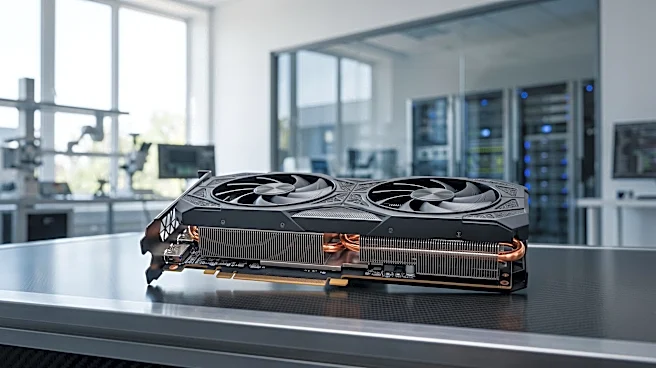
of these products, which are crucial for artificial intelligence and robotics development. Despite U.S. export restrictions on certain advanced semiconductors, Nvidia's revenue from China and Hong Kong reached $11.05 billion in the quarter ending October 25, 2026, a substantial increase from $2.97 billion a year prior. To maintain its presence, Nvidia has marketed lower-performance graphics cards and computer solutions to Chinese customers. The RTX PRO 5500, a professional workstation graphics card capable of AI applications, is particularly affected, with Chinese buyers having placed orders for over six million units, valued at a potential $70 billion, before the trade uncertainty escalated.
Why It's Important?
This situation is critical for the U.S. technology sector and its global market position. Nvidia, a leading U.S. chip manufacturer, faces a significant challenge in one of its largest markets. The potential for expanded U.S. export controls not only impacts Nvidia's revenue and market share but also signals a broader trend of technological decoupling between the U.S. and China. This could lead to Chinese companies, such as Huawei and Cambricon, accelerating their efforts to develop indigenous AI chip solutions, thereby reducing China's reliance on U.S. technology. The uncertainty also affects Chinese companies that depend on Nvidia's architecture and software tools, requiring them to adapt programs and conduct compatibility tests if they switch to alternative hardware, which is a time-consuming and resource-intensive process.
What's Next?
The future of Nvidia's operations in China hinges on regulatory decisions by U.S. authorities. U.S. officials and lawmakers are currently evaluating whether to extend export controls to other components used in robots, drones, and autonomous equipment, including Jetson processors. Any modifications to these controls will directly impact Nvidia's ability to serve the Chinese market. Chinese customers are likely to continue delaying orders until there is greater clarity on potential restrictions, making long-term planning difficult for both suppliers and buyers. This ongoing uncertainty is also creating opportunities for Chinese semiconductor manufacturers to fill the void, potentially leading to a more competitive and localized AI chip market within China.
Beyond the Headlines
The challenges faced by Nvidia in China underscore the complex interplay between technology, trade, and national security. The U.S. government's actions, aimed at limiting China's access to advanced technology, could inadvertently accelerate China's drive for technological self-sufficiency. This could lead to a bifurcated global technology landscape, where different regions operate on distinct hardware and software ecosystems. Such a scenario would not only impact the profitability of U.S. tech giants but also raise questions about global interoperability, innovation, and the potential for increased geopolitical tensions. The long-term implications could include a shift in global technological leadership and a reordering of international supply chains, with significant economic and strategic consequences for the U.S.