







What's Happening?
Greenfield Robotics, a Kansas-based company specializing in autonomous weed-cutting robots, has initiated a public share offering to raise up to $18.6 million. The offering, conducted through a Regulation A+ on StartEngine, is open to both accredited
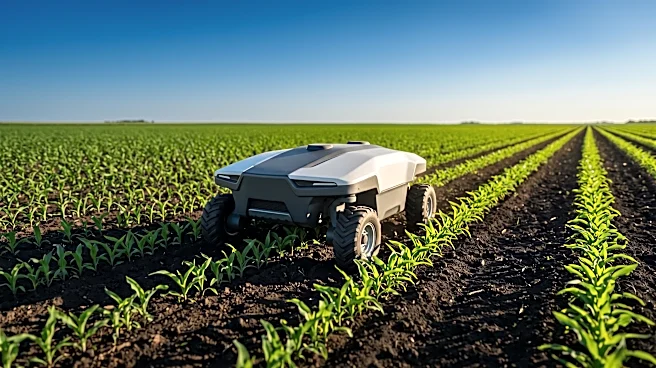
and non-accredited U.S. and international investors, with shares priced at $2.07 each. The company's robots mechanically cut weeds, aiming to reduce reliance on herbicides. Greenfield Robotics currently has 82 robots operating in 16 states, and its 2026 season for robot sales was fully booked, generating over $1 million. The company plans to expand its autonomous platform beyond weeding to include tasks such as feeding crops, seeding, mulching cover crops, and planting cash crops. This public offering follows six years of its machines operating in commercial crop fields and builds on previous funding rounds that attracted approximately 2,600 shareholders.
Why It's Important?
This public offering by Greenfield Robotics signifies a growing trend in agricultural technology towards automation and sustainable farming practices in the U.S. The development of autonomous weed-cutting robots offers a potential solution to several critical challenges facing American agriculture, including increasing herbicide resistance in weeds, environmental concerns associated with chemical use, and the rising costs of manual labor. By providing a mechanical alternative to herbicides, Greenfield Robotics could help U.S. farmers reduce their environmental footprint and potentially improve crop health. The involvement of institutions like Cornell University, the University of Wisconsin, and the University of Nebraska in researching these robots, along with the U.S. Department of Agriculture running the fleet at Grand Farm, underscores the potential impact and validation of this technology within the agricultural sector. This shift could lead to significant changes in farming operations, potentially benefiting farmers by reducing input costs and increasing efficiency, while also addressing consumer demand for more sustainably produced food.
What's Next?
Greenfield Robotics intends to use the proceeds from this public offering for manufacturing and production, field operations, research and development, and general company costs. A key aspect of their growth strategy involves a manufacturing partnership with Amity Technology in Fargo, North Dakota, which has established a production line to scale up robot manufacturing. North Dakota has committed $500,000 towards a dedicated production facility for this work. The company plans to extend its autonomous platform to perform additional tasks beyond weeding in the next season, including feeding crops, seeding, mulching cover crops, and planting. Greenfield Robotics is also considering introducing a lease option for its robots in the future, moving away from its previous pay-per-use service model. The success of this public offering and the subsequent expansion of manufacturing and operational capabilities will determine the pace at which this technology is adopted across U.S. farms.
Beyond the Headlines
The emergence of companies like Greenfield Robotics highlights a broader transformation in U.S. agriculture driven by technological innovation and environmental pressures. The increasing legal and regulatory scrutiny on herbicides, coupled with the growing problem of herbicide-resistant weeds, creates a significant market opportunity for alternative solutions. This shift towards robotic farming not only addresses immediate agricultural challenges but also contributes to the long-term sustainability of the food system. The personal motivation of founder Clint Brauer, who developed the technology after his father's Parkinson's diagnosis, underscores the human element driving innovation in this sector. The adoption of such technologies could lead to a more resilient and environmentally friendly agricultural landscape, potentially influencing policy decisions regarding chemical use in farming and fostering further investment in agritech research and development across the nation.