





What's Happening?
China's 'National Team,' comprising government-associated investment firms like the National Social Security Fund and state-owned investment houses, has reportedly begun buying stocks again to stabilize the onshore market. This intervention, similar to past
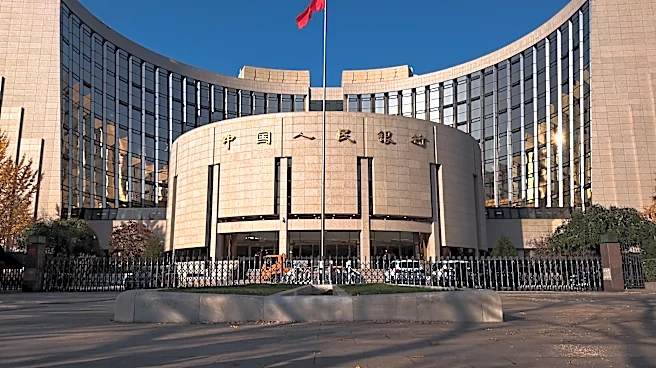
actions, involves significant inflows into domestic equity ETFs listed in China. Over the last month, eleven ETFs have received over $1 billion each, totaling $44.15 billion in inflows, with overall equity ETF inflows reaching $58.57 billion. Unlike previous interventions that focused on mega-cap stocks and state-owned enterprises, the current strategy appears broader, including technology stocks, mid-cap, and small-cap ETFs, as well as those tracking the Science and Technology (STAR) Board. The People's Bank of China (PBOC) is also supporting these efforts by meeting with financial institutions, extending swap facilities to banks, and lowering interest rates for stock buybacks.
Why It's Important?
This intervention by China's 'National Team' signals a strong government commitment to supporting its stock market, which can have ripple effects on global financial markets. For U.S. investors, understanding these actions is crucial as China's market stability can influence global economic sentiment and investment flows. The broadened scope of purchases, including technology and small-cap stocks, suggests a more comprehensive approach to market support, potentially benefiting a wider range of companies. Historically, such interventions have preceded bull market periods in China's equity market, offering potential opportunities for investors tracking these trends. The PBOC's monetary policy support further reinforces the government's resolve, indicating a coordinated effort to bolster market confidence and prevent significant downturns, which could indirectly impact U.S. companies with exposure to the Chinese market.
What's Next?
The current trend of increased inflows into Mainland China-listed equity ETFs, driven by the 'National Team,' is expected to continue, given the substantial 'dry powder' held by entities like Central Huijin. The ongoing policy support from the PBOC, including discussions with financial institutions and the extension of swap facilities, suggests a sustained effort to stabilize and potentially boost the stock market. Investors will be closely watching for further announcements from government-affiliated entities and the central bank regarding market support measures. The performance of ETFs like the KraneShares CSI China Internet ETF (KWEB), KraneShares China Semiconductor & Technology STAR Market 50 Index ETF (KSTR), and KraneShares MSCI China A 50 Connect Index ETF (KBA) will be key indicators of the effectiveness of these interventions. Continued stability in China's markets could encourage foreign investment and contribute to broader global market confidence.
Beyond the Headlines
The 'National Team's' intervention highlights the unique role of state influence in China's market economy. While such actions can provide short-term stability, they also raise questions about market autonomy and the long-term implications of government-directed capital allocation. The shift to include technology and smaller-cap stocks suggests a strategic move to support innovation and emerging sectors, aligning with China's broader economic development goals. However, this level of intervention can also create moral hazard, potentially distorting market signals and investor behavior. For international investors, it underscores the importance of understanding the interplay between market forces and state policy in China. The effectiveness and sustainability of these interventions will be a critical factor in shaping perceptions of China's financial market maturity and its attractiveness for global capital.