






What's Happening?
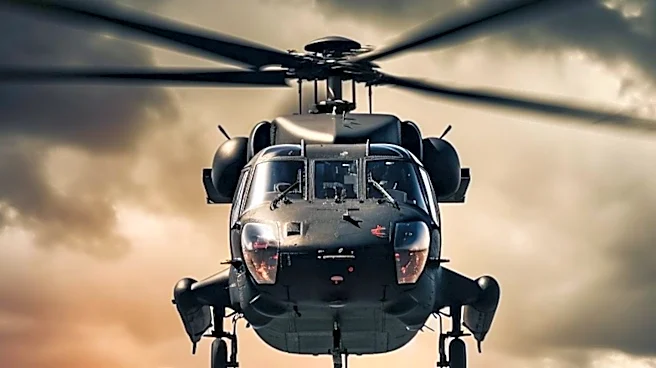
Kathryn Bigelow's 2012 film 'Zero Dark Thirty,' which chronicles the 2011 raid that resulted in the death of Osama Bin Laden, featured stealth helicopters that were fabrications for the movie. While the aircraft in the film appeared realistic, they were designed
by the crew based on available information and reports following the real-world operation. The existence of highly classified stealth helicopters became public knowledge after one of these aircraft was damaged during the raid in Abbottabad, Pakistan, and subsequently destroyed by U.S. Special Operations personnel to prevent its technology from falling into the wrong hands. Pakistan later shared images and video of the downed helicopter, which led to the unofficial identification of the MH-X Silent Hawk, a modified UH-60 Black Hawk with angular designs and altered rotor blades, resembling the F-117 Nighthawk stealth fighter.
Why It's Important?
The depiction of these stealth helicopters in 'Zero Dark Thirty' highlights the intersection of classified military technology and public perception, particularly in the context of national security operations. The film's effort to accurately portray a highly secretive asset, even through fabrication, underscores the public's fascination with advanced military capabilities and the challenges of maintaining secrecy in an information-driven world. For the U.S. military and intelligence community, the incident of the downed helicopter and its subsequent cinematic representation illustrate the constant tension between operational security and the inevitable leakage of information. It also demonstrates how popular culture can both inform and misinform the public about sensitive defense technologies, shaping narratives around national security events.
What's Next?
The ongoing interest in the MH-X Silent Hawk and similar classified military technologies suggests that future films and media productions will likely continue to explore and speculate on advanced defense capabilities. This could lead to further public discussion about military spending, technological innovation in defense, and the ethical implications of such advancements. For the defense industry, the incident serves as a reminder of the importance of robust security measures for classified projects. The public's engagement with such topics, even through fictionalized accounts, can influence policy debates and public support for defense initiatives, potentially impacting future research and development in stealth technology and special operations.
Beyond the Headlines
The story of the stealth helicopters in 'Zero Dark Thirty' delves into the broader implications of technological secrecy and its role in geopolitical strategy. The fact that a highly classified piece of military hardware was revealed due to an operational mishap, and then subsequently depicted in a major motion picture, highlights the inherent difficulties in controlling information in the modern era. This incident also raises questions about the balance between national security interests and public transparency. The film's creative team, by meticulously studying available evidence to reconstruct the helicopter, inadvertently contributed to the public's understanding, albeit fictionalized, of a secret military asset. This dynamic underscores how information, once released, can take on a life of its own, influencing both public discourse and artistic interpretations of historical events.