








What's Happening?
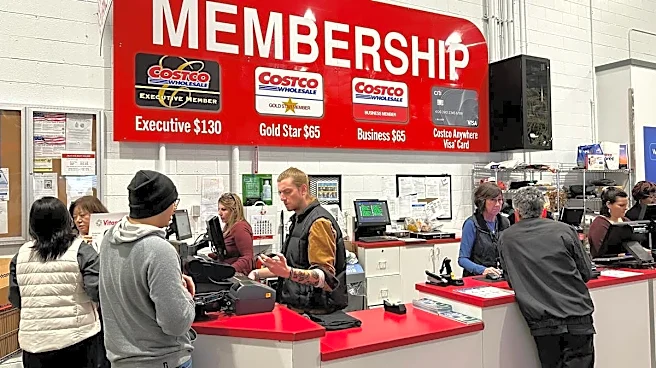
Financial analyst Jim Cramer has issued a warning regarding Costco's stock valuation, suggesting that its current price-to-earnings ratio of 47 times trailing earnings is a mistake for loyal shoppers. This caution comes as Costco has experienced declining
comparable sales for four consecutive reporting periods and a slower renewal cadence for its membership cards, particularly among online sign-ups. In contrast, discount retailers such as Five Below, Dollar Tree, and Dollar General have reported strong quarterly results, indicating a significant 'trade-down' trend among consumers. Cramer highlights that while Costco's membership fees still show growth, the underlying structural issue of retaining members, especially newer digital ones, poses a challenge that a rebound in gasoline traffic cannot fully address.
Why It's Important?
Cramer's analysis underscores a significant shift in U.S. retail dynamics, where value-oriented discount stores are gaining traction while traditionally strong retailers like Costco face headwinds. This trend reflects evolving consumer spending habits, likely influenced by economic pressures and a heightened focus on affordability. The 'trade-down' phenomenon, where consumers opt for lower-priced alternatives, impacts not only individual company performance but also the broader retail landscape. For investors, it signals a potential re-evaluation of growth stocks versus value stocks within the retail sector. The struggle of a membership-based model like Costco to retain members, particularly newer generations, could indicate a long-term challenge to its business model, affecting its operating leverage which heavily relies on membership fees. This shift could lead to a reallocation of investment capital towards discount retailers, impacting market valuations across the sector.
What's Next?
The retail sector will likely continue to observe the 'trade-down' trend, with discount retailers potentially sustaining their growth momentum as consumers prioritize value. Costco will need to address its declining comparable sales and membership renewal rates to regain investor confidence. This could involve strategic adjustments to its membership model, pricing, or product offerings to appeal to a broader or more loyal customer base. Investors will be closely watching for signs of improvement in Costco's key metrics, particularly its membership retention and comparable sales figures. Conversely, the strong performance of dollar stores and Five Below suggests continued opportunities for growth in the discount retail segment, potentially attracting further investment and expansion in this area. The long-term sustainability of these trends will depend on broader economic conditions and consumer purchasing power.
Beyond the Headlines
The divergence in performance between Costco and discount retailers highlights a deeper societal and economic narrative: the increasing financial strain on U.S. households. Cramer's concern about a 'generational thing' regarding Costco's appeal suggests a potential shift in brand loyalty and consumer values across different age groups. The success of dollar stores, even attracting middle- and high-income cohorts, indicates that the pursuit of value is becoming more universal, transcending traditional income brackets. This trend could lead to a redefinition of what constitutes 'value' in the consumer's mind and how retailers adapt their strategies to meet these evolving expectations. It also raises questions about the long-term implications for consumer discretionary spending and the overall health of the U.S. economy, particularly if real wages do not accelerate meaningfully at the lower end of the income spectrum.