







What's Happening?
UFORCE, a defense-technology company with major hubs in Kyiv and Washington, D.C., has successfully raised $700 million in a Series A financing round, valuing the company at $6 billion. The funding round was co-led by Valor Equity Partners and the UK
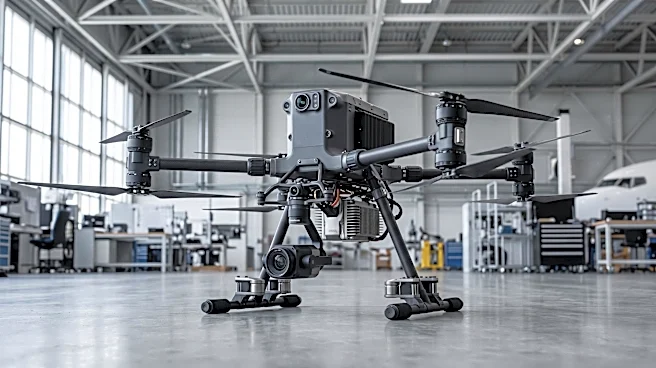
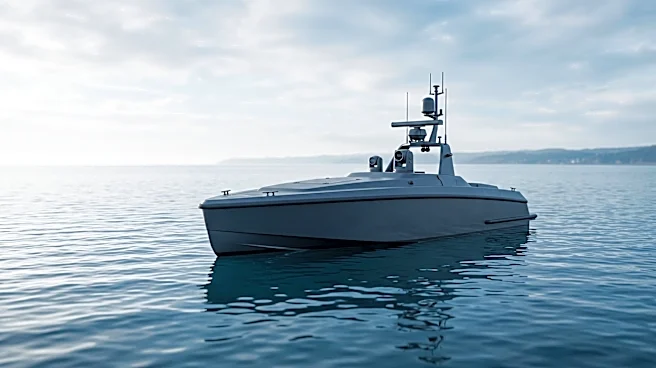
National Wealth Fund, with additional participation from the U.S.-Ukraine Reconstruction Investment Fund (URIF) and other leading investors from Silicon Valley, Europe, and Asia. This significant investment will enable UFORCE to expand and distribute its production capacity across the U.S., Europe, Asia-Pacific, and the Middle East. The company aims to manufacture its autonomous uncrewed platforms—including MAGURA USVs, NEMESIS UAVs, LIUT UGVs, and PREDATOR turrets—closer to operational theaters, while also helping allied nations enhance their sovereign manufacturing capabilities. General (Ret.) Christopher G. Cavoli, former NATO Supreme Allied Commander Europe, has joined the UFORCE board.
Why It's Important?
This substantial investment in UFORCE has direct and significant implications for U.S. national security and defense strategy. By scaling the production of combat-proven autonomous systems, UFORCE directly supports Ukraine's defense efforts, which aligns with U.S. foreign policy objectives of countering Russian aggression. The expansion of manufacturing capacity into the U.S. and other allied nations strengthens the global defense industrial base, reducing reliance on single points of production and enhancing supply chain resilience. This is crucial for the U.S. as it seeks to maintain a technological edge and ensure the availability of advanced defense systems for its own forces and allies. The involvement of U.S. investment funds and the U.S.-Ukraine Reconstruction Investment Fund underscores a commitment to fostering innovation and economic recovery in Ukraine, while simultaneously bolstering the defense capabilities of the U.S. and its partners.
What's Next?
The newly secured capital will support expanded research and development and increased production of UFORCE's key autonomous platforms. UFORCE plans to continue converting existing maritime and automotive manufacturing capacity in allied nations to support defense needs, as exemplified by its partnership with ReconCraft to scale U.S. manufacturing of MAGURA USVs. The company will also deepen its role as a founding member of the EU-Ukraine Drone Alliance and build upon its partnerships within NATO and the Joint Expeditionary Force (JEF) networks. This distributed production model is designed to ensure continuous supply to front-line troops and bring advanced capabilities to the battlefield. The involvement of General (Ret.) Christopher G. Cavoli on the board is expected to provide strategic guidance and further integrate UFORCE's innovations with allied defense needs.
Beyond the Headlines
The rise of companies like UFORCE, specializing in cost-effective, combat-proven autonomous systems, signals a paradigm shift in modern warfare. The investment highlights a growing recognition among global investors and defense strategists that future conflicts will increasingly rely on uncrewed platforms and AI-driven solutions. This trend has profound ethical implications regarding autonomous decision-making in combat and the potential for reduced human oversight. Economically, it could lead to a boom in the defense-tech sector, attracting more private capital and fostering rapid innovation. Culturally, the widespread deployment of such systems could alter public perception of warfare, potentially desensitizing societies to conflict. The distributed manufacturing model also suggests a move towards more localized and resilient defense production, which could have long-term impacts on global supply chains and industrial policy, reducing dependence on traditional defense manufacturing hubs.