





What's Happening?
Architect Labs, a Palo Alto-based startup, announced that its AI systems have designed a new general-purpose CPU architecture named Frostbite. This CPU, according to the company, was developed from scratch, with AI agents inventing its instruction set,
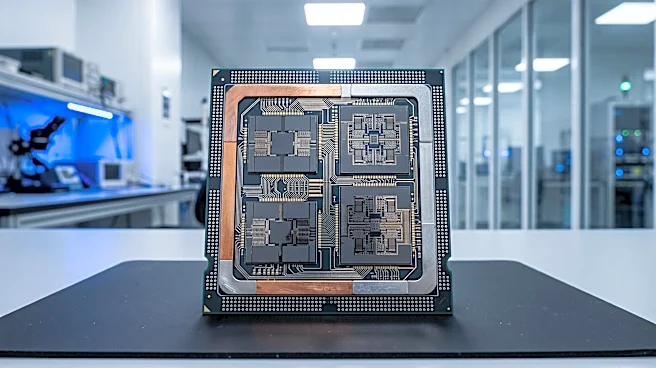
microarchitecture, and physical layout. In pre-silicon simulations, a four-tile Frostbite cluster demonstrated 4.59 times the performance per watt compared to a 'silicon-proven' dual-issue, in-order CPU core of similar size. The design, synthesized on a 7nm process, achieved 500 MHz in its final layout. The company states that the AI agents started with 'zero architectural priors,' learning from papers and benchmarks to develop the architecture. The Frostbite CPU utilizes interaction nets, a computational model from 1990, where programs are represented as graphs, allowing for inherent parallelism without traditional out-of-order execution hardware or complex cache coherence protocols. The company has not yet produced physical silicon for Frostbite and has not disclosed the name of the comparison CPU for legal reasons.
Why It's Important?
This development signifies a potential paradigm shift in CPU design, moving from human-led engineering to AI-driven innovation. If Architect Labs' claims hold true in silicon, the Frostbite CPU could offer substantial improvements in energy efficiency and performance per area, particularly for workloads that can leverage its inherent parallelism. This could lead to more powerful and energy-efficient computing devices, impacting various sectors from data centers to edge computing. The approach of using AI to design fundamental hardware components could accelerate the development cycle and potentially uncover novel architectural solutions that human designers might overlook. The reliance on interaction nets also suggests a departure from conventional CPU architectures, which could necessitate new software development paradigms and compiler optimizations, creating both challenges and opportunities for software developers and hardware manufacturers.
What's Next?
Architect Labs plans to further validate Frostbite's capabilities by conducting more extensive benchmarks, including comparisons against multi-core and out-of-order CPUs using popular suites like SPEC and PARSEC. The company also intends to release an FPGA-hosted 'software playground' for developers to run programs on Frostbite, along with a preliminary operating system. Eventually, Architect Labs aims to make Frostbite's Register-Transfer Level (RTL) and instruction set publicly available. The next critical step will be the fabrication of physical silicon to verify the simulated performance and power efficiency in real-world conditions. The success of these future steps will determine whether Frostbite can transition from a promising AI-designed concept to a commercially viable general-purpose CPU alternative, potentially attracting investment and partnerships from major semiconductor players.
Beyond the Headlines
The emergence of AI-designed CPUs like Frostbite raises profound questions about the future of hardware engineering and the role of artificial intelligence in creative and complex design processes. This initiative challenges the long-standing human-centric approach to CPU architecture, suggesting that AI can not only optimize existing designs but also invent entirely new computational paradigms. The 'zero architectural priors' approach highlights AI's ability to explore unconventional solutions, potentially leading to breakthroughs that human biases might prevent. Furthermore, the reliance on interaction nets, a concept from the 1990s, demonstrates how AI can unearth and re-contextualize older, less explored ideas with modern computational power. This could lead to a broader re-evaluation of foundational computer science theories and their practical applications, fostering a new era of innovation where AI acts as a co-creator in fundamental technological advancements.