


What's Happening?
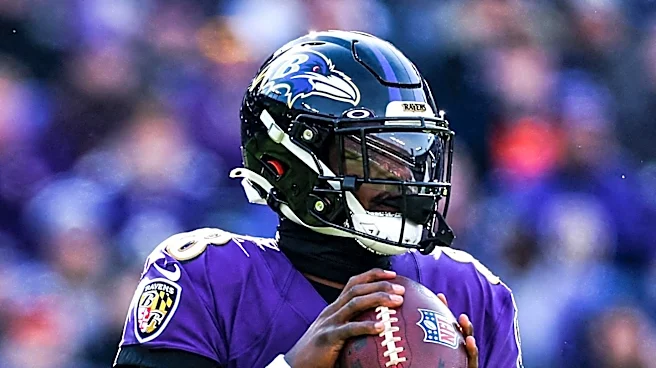
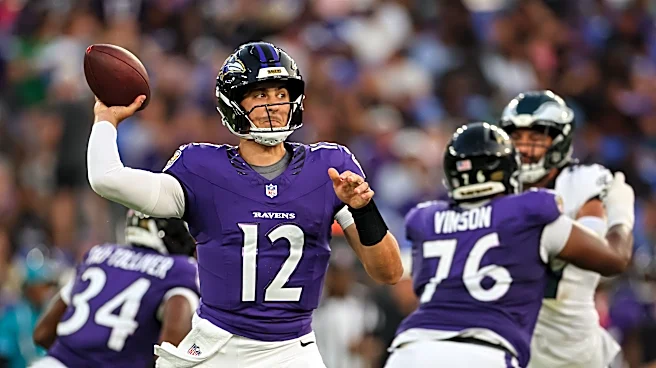
Baltimore Ravens quarterback Lamar Jackson is undergoing a significant adjustment to his footwork as he adapts to the team's new offensive scheme under coordinator Declan Doyle and quarterbacks coach Israel Woolfork. Historically, Jackson has played with
a 'right foot open' stance, where his right foot was staggered ahead of his left. This stance was consistent throughout his Heisman Trophy-winning college career and his two NFL MVP seasons. However, the new offense, rooted in Bill Walsh’s West Coast offense principles, demands a 'left foot open' stance, with the left foot staggered ahead of the right. This change is crucial for timing and rhythm within Doyle's system, which emphasizes precise three- and five-step drops to align with receiver routes. Woolfork, who has previously helped other NFL quarterbacks like Kyler Murray and Deshaun Watson with similar adjustments, noted that the initial transition was 'awkward' for Jackson. Despite the challenge, Jackson has been diligently working on this new technique, with Woolfork observing that it is 'starting to become second nature.' The coaching staff believes that mastering this footwork will allow Jackson's natural abilities to shine within the structured timing of the new offense.
Why It's Important?
The modification of Lamar Jackson's footwork is a critical development for the Baltimore Ravens, potentially impacting their offensive performance and Jackson's long-term career trajectory. Footwork is fundamental to a quarterback's accuracy, timing, and ability to progress through reads efficiently. By aligning Jackson's footwork with the precise demands of the new West Coast-style offense, the Ravens aim to enhance his passing game, making him more consistent and effective from the pocket. This shift could lead to improved completion percentages and a more balanced offensive attack, moving beyond the run-heavy schemes of previous years. For Jackson, successfully adapting to this change demonstrates his commitment to evolving as a passer and could unlock new dimensions in his game, potentially extending his career and increasing his value. Conversely, any struggles in fully integrating the new footwork could hinder the offense's rhythm and limit its potential. The success of this transition will also serve as a significant test for coordinator Declan Doyle and quarterbacks coach Israel Woolfork, validating their strategic vision for the team's offensive future and their ability to develop elite talent.
What's Next?
As the NFL season progresses, all eyes will be on Lamar Jackson's performance to see how effectively he has integrated the new footwork into his game. The initial 'awkwardness' noted by coach Woolfork suggests that while progress has been made, consistent application under game-day pressure will be the true test. Fans and analysts will be scrutinizing his accuracy, timing, and overall comfort in the pocket. The coaching staff will continue to reinforce the new technique through practice and film study, providing feedback to ensure the footwork becomes fully ingrained. The success of this adjustment could influence future offensive strategies for the Ravens, potentially leading to a more pass-centric approach. If Jackson thrives, it could also inspire other teams to consider similar fundamental changes for their quarterbacks, especially those with unique athletic profiles. Conversely, if the new footwork proves to be a hindrance, the coaching staff may need to re-evaluate their approach, potentially making further adjustments or finding a compromise that best suits Jackson's natural mechanics while still fitting the offensive scheme. The ongoing development will be a key storyline throughout the season.
Beyond the Headlines
The subtle yet significant change in Lamar Jackson's footwork highlights a deeper philosophical shift in modern NFL coaching and player development. It underscores the increasing emphasis on precision and technical refinement, even for highly athletic and improvisational quarterbacks. This move suggests a belief that even the most naturally gifted players can benefit from fundamental adjustments to optimize their performance within a structured system. It also reflects a broader trend in sports where data analytics and biomechanics are used to identify marginal gains that can lead to substantial improvements. The challenge for Jackson is not just physical but also mental, as he must unlearn years of ingrained habits and adopt new ones under intense scrutiny. This process can be a metaphor for adaptation in any high-performance environment, where continuous learning and willingness to change are paramount. The success or failure of this experiment could influence how future generations of quarterbacks are coached, potentially leading to a more standardized approach to footwork and mechanics across the league, even for those known for their unconventional styles. It also raises questions about the balance between preserving a player's unique strengths and conforming to a system's demands.