






What's Happening?
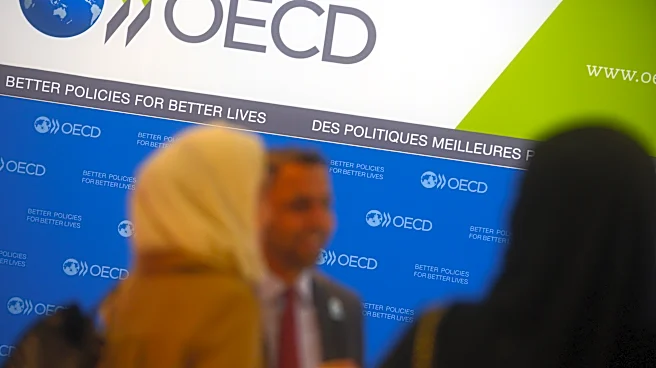
The Organisation for Economic Co-operation and Development (OECD) has noted Poland's significant economic progress, with its GDP per capita, adjusted for purchasing power parity, projected to nearly match Spain's and surpass Japan's by 2026. Forecasts
from the International Monetary Fund (IMF) indicate Poland's GDP per capita will reach 60,051 international dollars, compared to Spain's 60,106 and Japan's 59,712. This convergence reflects Poland's economic transformation since its transition from a planned economy in the early 1990s, driven by reforms like the Balcerowicz Plan, which liberalized prices and trade. The World Bank attributes this development to strong institutions, protection of property rights, competition, macroeconomic stability, and integration into international markets. Poland's accession to the European Union in 2004 further bolstered this growth through access to the single market, foreign investment, and EU funding. The OECD specifically highlights the role of an educated population and a business-friendly environment in attracting investment and new businesses.
Why It's Important?
Poland's economic trajectory offers a case study for developing economies on the impact of strategic reforms and international integration. The country's ability to leverage education and technology absorption to attract investment and foster business activity demonstrates a pathway for sustained growth. For the U.S. and other advanced economies, Poland's rise signifies a shifting global economic landscape, potentially leading to new trade and investment opportunities. The IMF's warning that technology transfer loses momentum as an economy approaches the productivity frontier is crucial, suggesting that Poland must now focus on homegrown innovation to maintain its growth. This shift could influence U.S. foreign policy and economic partnerships, as nations like Poland seek to strengthen their domestic technological capabilities. The comparison with Japan, an advanced economy facing challenges like an aging population, underscores the demographic and structural hurdles that can impact long-term economic vitality, providing insights for U.S. policymakers addressing similar issues.
What's Next?
To sustain its economic progress, Poland will need to prioritize strengthening homegrown innovation, as the IMF warns that technology transfer's impact as a growth driver diminishes as an economy matures. This focus on domestic innovation will be critical in confronting challenges such as an aging population, labor shortages, and pressure on public finances. The U.S. and other international partners may see opportunities to collaborate with Poland on research and development initiatives, fostering mutual economic benefits. Poland's continued integration into the global economy, particularly within the European Union, will likely involve further efforts to modernize its production and infrastructure. The country's experience could also serve as a model for other nations undergoing economic transitions, prompting discussions on best practices for reform, institutional development, and leveraging education and technology for growth. Future economic forecasts will closely monitor Poland's ability to transition from a technology-absorbing economy to an innovation-driven one.
Beyond the Headlines
Poland's economic ascent highlights the profound impact of political and economic reforms on national development. The transition from a planned economy to a market-driven system, coupled with strategic integration into the European Union, has not only boosted its GDP but also transformed its societal fabric. This success story challenges conventional notions of economic development, demonstrating that with the right policies and institutional frameworks, nations can rapidly bridge economic divides. The emphasis on education and technology absorption points to a broader global trend where human capital and technological prowess are becoming increasingly critical for economic competitiveness. For the U.S., this underscores the importance of investing in education and fostering an environment conducive to technological innovation to maintain its economic leadership. The long-term implications include potential shifts in global supply chains and investment patterns as countries like Poland become more attractive destinations for high-tech industries and skilled labor.