




What's Happening?
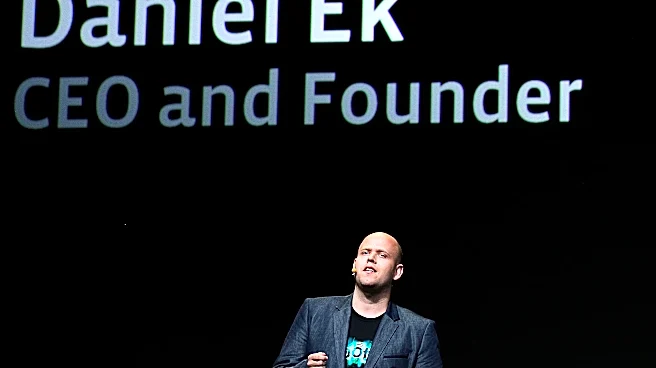
In 2010, Ashton Kutcher's investment firm, A-Grade, invested $3 million in Spotify, the Swedish music streaming service co-founded by Daniel Ek and Martin Lorentzon. Spotify's business model aimed to revolutionize music consumption by offering users access
to a vast music library for a monthly fee, alongside an ad-supported free tier, thereby making music ownership less necessary. This investment was part of A-Grade's strategy to back companies whose products its partners could personally evaluate and assist with marketing and brand building. By 2016, Forbes reported that the value of A-Grade's stake in Spotify had at least tripled. Spotify subsequently went public on the New York Stock Exchange via a direct listing on April 3, 2018. As of November 24, 2026, Spotify's market value stood at approximately $123 billion.
Why It's Important?
This early investment by A-Grade in Spotify highlights a significant trend in venture capital, where celebrity investors leverage their influence and business acumen to support emerging technology companies. For Spotify, securing investment from a high-profile entity like A-Grade not only provided crucial capital but also potentially enhanced its visibility and credibility in the competitive tech landscape. This move underscored a shift in consumer habits towards streaming services, predicting the decline of traditional music ownership. The substantial return on investment for A-Grade, with the stake tripling by 2016, demonstrates the lucrative potential of early-stage investments in disruptive technologies. Furthermore, Spotify's successful direct listing and subsequent market valuation of $123 billion by late 2026 illustrate the immense growth and impact of digital streaming platforms on the entertainment industry and global economy.
What's Next?
Following its successful direct listing in 2018 and significant market valuation, Spotify is expected to continue its expansion in the global audio streaming market. The company will likely focus on diversifying its content offerings beyond music, including podcasts and audiobooks, to attract and retain a broader subscriber base. Competition in the streaming sector remains intense, with major tech companies vying for market share, suggesting ongoing innovation in features, user experience, and exclusive content. Investors will be closely watching Spotify's strategies for sustained growth, profitability, and its ability to navigate evolving intellectual property rights and artist compensation models. The long-term trajectory of Spotify will depend on its capacity to adapt to technological advancements and shifting consumer preferences in the digital entertainment landscape.
Beyond the Headlines
The investment in Spotify by A-Grade reflects a broader cultural and economic shift towards the 'creator economy' and subscription-based services. This model challenges traditional ownership paradigms, moving consumers from purchasing physical or digital copies of media to accessing vast libraries on demand. The success of Spotify, backed by early investors like Ashton Kutcher, also highlights the increasing convergence of entertainment, technology, and finance, where celebrities are not just endorsers but active participants in shaping the future of digital industries. This trend raises questions about the influence of celebrity capital on market trends and the democratization of investment opportunities. Furthermore, the valuation of Spotify at $123 billion by 2026 underscores the immense value placed on digital platforms that aggregate and distribute content, fundamentally altering how artists reach audiences and how consumers engage with media.