






What's Happening?
The Office of the U.S. Trade Representative (USTR), led by Jamieson Greer, has proposed a 15% tariff on goods imported from the European Union. This proposal stems from a trade investigation initiated in March under Section 301 of the Trade Act of 1974.
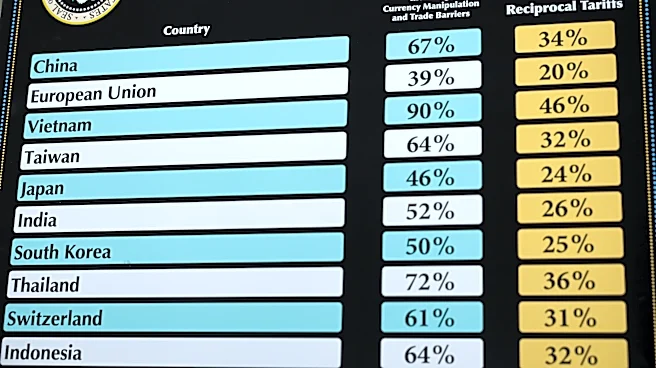
The USTR concluded that 14 trading partners, including the EU, China, and Japan, have artificially deflated prices by saturating markets with manufactured goods. This action aligns with the ceiling established in a transatlantic trade truce agreed upon in July 2025 between President Trump and European Commission President Ursula von der Leyen. This is the second trade probe launched by the Trump administration this spring as part of its strategy to re-establish tariff barriers. Earlier this year, after the U.S. Supreme Court invalidated 'reciprocal' duties imposed by President Trump in 2025, the administration implemented a 10% tariff on the EU, citing concerns over Brussels' failure to prohibit the import of goods produced with forced labor. A senior U.S. official indicated that the higher of the two tariff rates would be applied, not combined, and that the proposed duties are not expected to take effect until January at the earliest, following public hearings and comments.
Why It's Important?
This proposed tariff increase signifies a significant escalation in trade tensions between the United States and the European Union, potentially impacting various U.S. industries that rely on EU imports or export to the EU. The USTR's finding of 'artificially deflated prices' due to market flooding suggests a U.S. strategy to protect domestic manufacturing from what it perceives as unfair trade practices. For U.S. consumers, these tariffs could lead to higher prices for a range of imported goods from the EU. For U.S. businesses, particularly those involved in import/export with Europe, the tariffs could increase operational costs and reduce competitiveness. The EU is expected to resist this move, with European trade ministers likely to raise concerns about the excess capacity probe and the lack of progress on lowering existing U.S. tariffs on EU steel products. This situation could lead to retaliatory measures from the EU, further complicating transatlantic trade relations and potentially disrupting global supply chains. The broader implication is a continued shift towards protectionist trade policies by the U.S. administration, aiming to rebalance trade deficits and support domestic industries.
What's Next?
The proposed 15% tariffs on EU goods are not expected to be implemented immediately. The USTR will first conduct public hearings and gather comments from stakeholders. Jamieson Greer is scheduled to engage with European trade ministers next Monday, where he is anticipated to face considerable pushback regarding the excess capacity investigation. EU ministers are also expected to address the ongoing issue of U.S. tariffs on EU steel products, some of which remain as high as 50%. The earliest these new duties could take effect is January. The European Union may consider its own retaliatory measures or seek further negotiations to avert the tariffs. The outcome of these discussions and the public comment period will determine the final scope and implementation of the tariffs, potentially shaping the future of U.S.-EU trade relations. The situation could also influence broader international trade policy as other nations observe the U.S. approach to addressing perceived market imbalances.
Beyond the Headlines
This development extends beyond immediate trade implications, touching upon the broader philosophical debate regarding free trade versus protectionism. The USTR's use of Section 301 of the Trade Act of 1974 highlights a continued reliance on unilateral trade enforcement tools by the U.S. administration, which can be seen as a departure from multilateral trade dispute resolution mechanisms. The investigation into 'structural excess capacity' suggests a U.S. focus on the underlying industrial policies of trading partners, rather than just specific trade practices. This approach could set a precedent for future trade disputes, potentially leading to more frequent and broader investigations into the economic structures of other nations. Furthermore, the interplay between these new proposed tariffs and the existing 10% tariffs related to forced labor concerns underscores a complex and multi-faceted trade strategy. This layered approach could create significant uncertainty for international businesses and supply chains, forcing them to navigate a more unpredictable global trade environment. The long-term impact could be a re-evaluation of global manufacturing and sourcing strategies as companies seek to mitigate tariff risks.