





What's Happening?
Lightmatter, a company specializing in AI data center infrastructure, has successfully raised $400 million in its Series D funding round. This latest investment brings the company's valuation to $4.4 billion. Lightmatter is recognized for its innovation
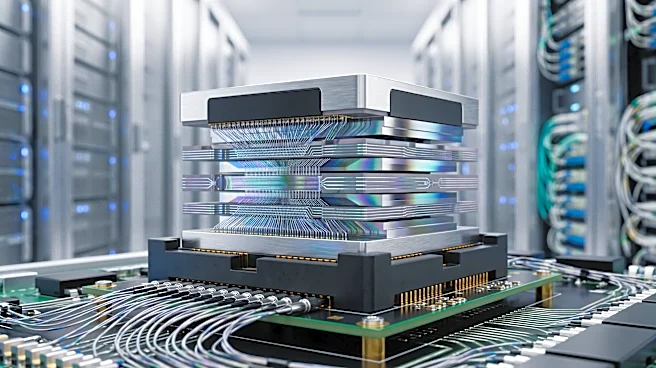
in photonic computing, particularly for inventing Passage™, the world's first 3D-stacked photonics engine. This technology is designed to connect a vast number of processors, ranging from thousands to millions, at the speed of light within extreme-scale data centers. The primary application of Passage™ is to support advanced Artificial Intelligence (AI) and High-Performance Computing (HPC) workloads. The company plans to utilize the new capital to further accelerate the development of data center photonics and expand its various departments.
Why It's Important?
This significant funding round for Lightmatter underscores the growing demand and investment in advanced infrastructure for AI and HPC. The development of photonic interconnect technology, as pioneered by Lightmatter, is crucial for overcoming the limitations of traditional electronic systems in handling the massive data flows required by modern AI. By enabling faster and more efficient data transfer, this technology can significantly enhance the performance and scalability of AI data centers. This advancement is vital for industries heavily reliant on AI, such as autonomous vehicles, scientific research, and complex data analytics, as it allows for more sophisticated models and faster processing times. The substantial valuation also signals investor confidence in the long-term potential of photonic computing to reshape the future of data center architecture and AI capabilities.
What's Next?
Lightmatter intends to use the $400 million Series D funding to accelerate the development of its data center photonics technology. This will likely involve further research and development into new generations of its Passage™ photonic engine and related products. The company also plans to expand its departments, suggesting an increase in hiring across engineering, research, and operational roles. This expansion will support the scaling of its technology and potentially its market reach. As Lightmatter continues to refine and deploy its photonic interconnect solutions, the broader AI and HPC industries can anticipate more efficient and powerful data center capabilities, potentially leading to breakthroughs in AI applications and computational science.
Beyond the Headlines
The success of Lightmatter highlights a broader shift in the computing landscape towards specialized hardware solutions for AI. As AI models become increasingly complex and data-intensive, the limitations of conventional silicon-based electronics are becoming more apparent. Photonic computing, which uses light instead of electrons for data transfer and processing, offers a promising pathway to overcome these bottlenecks, providing significant advantages in speed, energy efficiency, and bandwidth. This technological evolution could lead to a re-evaluation of data center design principles and a greater emphasis on optical technologies. Furthermore, the investment in companies like Lightmatter reflects a strategic national interest in maintaining a competitive edge in AI development, as advanced computing infrastructure is a foundational element for future technological leadership.