
What's Happening?
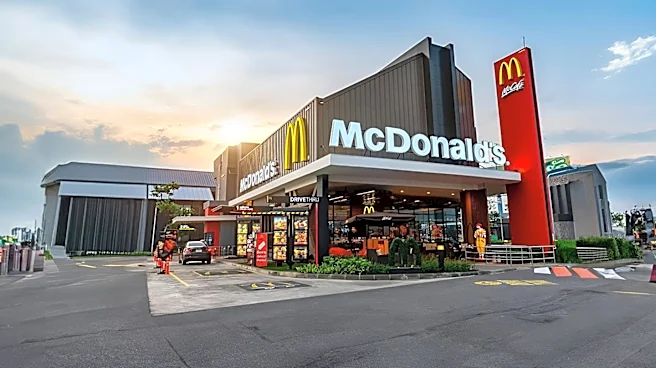
McDonald's is currently testing a new advertising pilot program across 450 company-owned restaurants, integrating YouTube-style advertisements onto drive-thru menu boards. This initiative is part of the
company's broader strategy to establish the 'McDonald's Media Network,' with an ambitious goal of generating $1 billion in revenue over time. The advertisements are designed to appear on the digital menu boards after a customer has placed their order, offering what McDonald's describes as 'post-purchase content that customers may find helpful, relevant, or interesting.' The company states that this pilot aims to explore new revenue streams with minimal additional costs, operational complexity, or disruption to the customer experience. While other major corporations like Amazon and Walmart have already developed their own media networks, McDonald's is positioning itself as a pioneer in the fast-food sector with this advertising model.
Why It's Important?
This move by McDonald's signifies a significant shift in how quick-service restaurants might leverage their physical spaces for advertising revenue. By transforming drive-thru menu boards into ad platforms, McDonald's could unlock a substantial new income stream, potentially reaching $1 billion. This strategy could set a precedent for the fast-food industry, prompting competitors to explore similar advertising models. For consumers, it means an increased exposure to advertisements in previously ad-free environments, potentially altering the drive-thru experience. The success of this pilot could influence how brands engage with customers in transactional settings, blurring the lines between service and advertising. It also highlights the growing trend of companies seeking to monetize every available customer touchpoint, reflecting a broader economic push for diversified revenue streams in competitive markets.
What's Next?
McDonald's will continue to evaluate the performance and customer reception of its drive-thru advertising pilot program. The company's stated intention is to expand the 'McDonald's Media Network' into a billion-dollar business, suggesting that if the pilot is successful, these advertisements could become a permanent fixture and potentially expand to more locations. The feedback from customers, which has already shown some negative reactions on social media comparing the ads to 'un-skippable' YouTube commercials, will likely play a role in refining the strategy. Other fast-food chains and businesses with high-traffic physical locations will be closely observing McDonald's progress, potentially leading to similar advertising integrations across various industries. The company will need to balance revenue generation with maintaining a positive customer experience to ensure long-term success.
Beyond the Headlines
The implementation of advertising on drive-thru menu boards raises deeper questions about the commercialization of public and semi-public spaces. As consumers increasingly encounter advertisements in every facet of their daily lives, from streaming services to physical retail environments, the concept of an 'ad-free' experience becomes rarer. This trend could lead to a societal discussion about the saturation of advertising and its psychological impact. Ethically, companies will need to consider the fine line between informative content and intrusive marketing, especially in captive environments like a drive-thru queue. Legally, there might be future considerations regarding data privacy and targeted advertising in these new contexts, although the current pilot focuses on general ads. Culturally, it reflects a growing acceptance, or perhaps resignation, to constant commercial messaging, potentially reshaping consumer expectations for brand interactions.