







What's Happening?
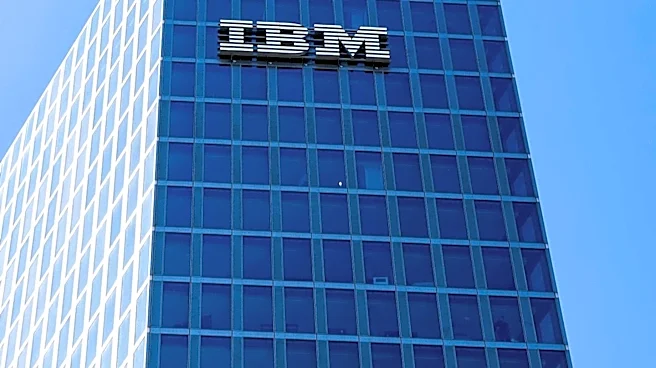
International Business Machines (IBM) is experiencing scrutiny regarding its stock valuation, particularly in light of its growing cash flow and strategic investments in quantum computing and enterprise AI partnerships. The company's stock has seen a 138.1%
return over the past five years. Analysts are using a Discounted Cash Flow (DCF) model, which focuses on the cash IBM can return to shareholders, to assess if the current share price of US$231.09 is justified. Latest twelve-month free cash flow stands at approximately $14.0 billion, with projections indicating growing cash generation into the early 2030s. Recent collaborations in quantum computing with NVIDIA and Fermilab, alongside advancements in modular quantum platforms and enterprise AI agents, are contributing to these optimistic cash flow estimates.
Why It's Important?
The valuation of IBM's stock is a significant indicator for the U.S. technology and investment sectors. The debate over whether IBM's current price is justified by its future cash flows highlights the market's assessment of its strategic shift towards hybrid cloud and AI. For investors, understanding this valuation is crucial for making informed decisions, as it reflects confidence in IBM's ability to monetize its advanced technology initiatives. The company's push into quantum computing and AI is not just about technological advancement but also about securing future revenue streams and market leadership. The differing 'bull' and 'bear' cases presented by Simply Wall St narratives underscore the uncertainty and varying perspectives on how quickly these investments will translate into tangible financial returns, impacting investor sentiment and potentially influencing broader market trends in the tech industry.
What's Next?
The market will continue to monitor IBM's execution on its hybrid cloud and AI strategies, as well as the progress of its quantum computing initiatives. The translation of these partnerships and investments into sustained revenue growth and stronger cash generation will be key to validating its current valuation. Investors will be looking for concrete evidence that projects like modular quantum platforms and enterprise AI agents are effectively contributing to the company's financial performance. Future announcements regarding financial results, new partnerships, and technological breakthroughs will likely influence the stock's trajectory and market perception. The ongoing debate between the 'bull' and 'bear' cases suggests that IBM's stock performance will remain a topic of close observation for financial analysts and investors.
Beyond the Headlines
IBM's strategic pivot towards AI and quantum computing represents a broader trend in the technology industry where companies are investing heavily in next-generation technologies to maintain relevance and drive growth. Beyond the financial metrics, this shift has profound implications for the future of computing and business operations. Quantum computing, while still in its nascent stages, promises to revolutionize fields from medicine to finance, and IBM's early involvement positions it as a potential leader. Similarly, the widespread adoption of enterprise AI agents could fundamentally change how businesses interact with data and automate processes. The success or challenges faced by IBM in these areas could serve as a bellwether for the wider adoption and commercial viability of these advanced technologies, influencing research and development priorities across the U.S. tech ecosystem.