
What's Happening?
Oil prices surged by over 2% on Wednesday after Yemen's Houthis claimed responsibility for drone attacks on Saudi Arabia's Ras Tanura refinery, the kingdom's largest. Brent crude traded at $93.60 per barrel,
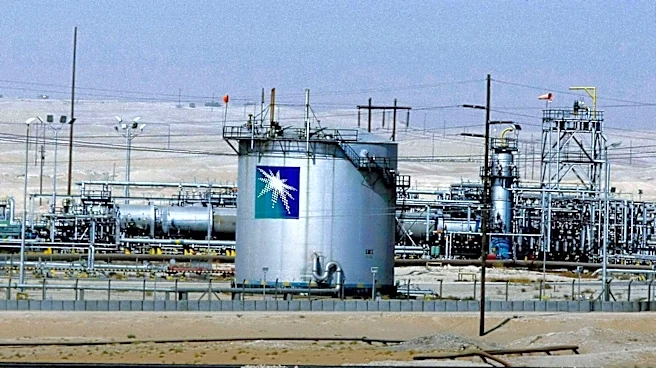
up 2.41%, while West Texas Intermediate rose to $83.51, an increase of 1.78%. Saudi-led coalition spokesman Turki Al-Maliki stated that air defenses intercepted four drones over Ras Tanura, with fragments falling without causing injuries. However, Houthi military spokesman Yahya Saree asserted that the strike was "accurate and direct," leading to fires at the site. NASA satellite imagery reviewed by Reuters showed thick black smoke covering approximately 600 square kilometers around the refinery. Saudi Aramco and the Saudi government have not yet commented on the incident. This attack follows a series of Houthi claims targeting Saudi energy infrastructure throughout the autumn.
Why It's Important?
The drone attacks on Saudi Arabia's critical oil infrastructure, particularly the Ras Tanura refinery which processes 550,000 barrels per day (about 16% of Saudi refining capacity), have significant implications for global energy markets and U.S. consumers. The immediate rise in oil prices reflects increased geopolitical risk premium, as highlighted by PVM oil analyst Tamas Varga. Higher oil prices can translate to increased gasoline costs for U.S. consumers and higher operational expenses for businesses, potentially impacting inflation and economic stability. The repeated targeting of Saudi facilities by the Houthis underscores the ongoing instability in the Middle East, which can disrupt global oil supply chains and create uncertainty for energy investors. This situation also highlights the vulnerability of critical energy infrastructure to drone attacks, prompting concerns about energy security worldwide.
What's Next?
The immediate aftermath will likely involve continued monitoring of the situation in Saudi Arabia and the broader Middle East for further escalations. Oil prices are expected to remain volatile as traders assess the geopolitical risks and potential impacts on supply. The upcoming OPEC+ meeting will also be crucial, as uncertainty over their policy for 2027 is already contributing to price fluctuations. Saudi Arabia will likely enhance its air defense capabilities around key energy installations, and international pressure may mount on the Houthis to cease attacks on civilian and economic targets. For the U.S., the administration will likely continue to monitor global oil markets and potentially engage in diplomatic efforts to de-escalate tensions in the region to mitigate economic impacts.
Beyond the Headlines
Beyond the immediate economic impact of rising oil prices, these attacks highlight the evolving nature of warfare and the increasing threat posed by drone technology to critical infrastructure. The ability of non-state actors like the Houthis to target sophisticated oil facilities with drones presents a significant challenge to national security and energy resilience. This situation could accelerate global efforts to develop more robust counter-drone technologies and enhance cybersecurity measures for industrial control systems. Furthermore, the repeated attacks underscore the complex geopolitical dynamics in the Middle East, where regional rivalries and proxy conflicts continue to destabilize global energy supplies. The long-term implications could include a re-evaluation of global energy supply routes and a push towards greater energy independence or diversification by major consuming nations.