





What's Happening?
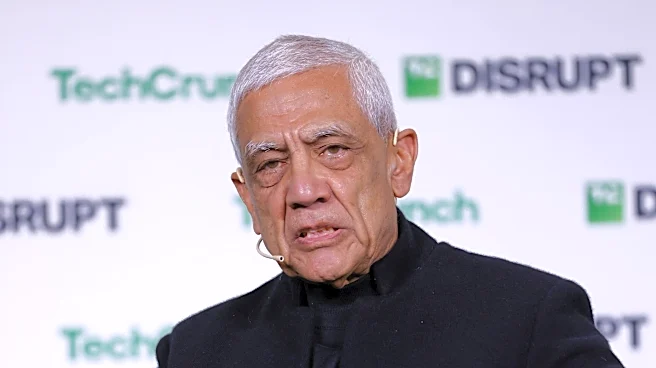
Billionaire venture capitalist Vinod Khosla, co-founder of Sun Microsystems and an early investor in OpenAI, asserts that the true measure of artificial intelligence's boom should be its actual usage rather than fluctuating stock prices. Khosla, speaking
on Yahoo Finance's Deirdre Bosa Live, emphasized measuring AI's impact in 'tokens'—the units of text processed by AI models. This perspective comes as Wall Street grapples with concerns about whether AI constitutes a market bubble, particularly given that leading AI infrastructure companies are spending heavily on computing power. Combined free cash flow for major tech companies like Amazon, Alphabet, Meta, Microsoft, and Oracle reportedly fell to approximately minus $31 billion in the third quarter, a significant drop from previous positive figures. Despite this, AI labs are seeing substantial growth, with OpenAI's quarterly revenue increasing by nearly 50% to $10 billion.
Why It's Important?
Khosla's argument shifts the focus from speculative market valuations to tangible adoption and utility, which is critical for understanding the long-term viability of the AI sector. This perspective is particularly relevant for investors and policymakers trying to discern genuine technological advancement from market hype. If usage continues to grow, it suggests a fundamental shift in how businesses and consumers interact with technology, potentially leading to widespread economic transformation. The substantial investment by Big Tech in AI infrastructure, despite negative free cash flow, indicates a strong belief in future returns driven by this usage. This investment could lead to significant advancements and new applications, but also carries risks if the anticipated usage does not materialize or if overbuilding occurs, as seen during the dot-com bubble with telecom infrastructure.
What's Next?
The debate between AI's market valuation and its actual usage will likely continue to shape investment strategies and corporate spending in the technology sector. Companies will likely continue to invest heavily in AI infrastructure, betting on increased adoption across various industries. Monitoring metrics like 'tokens processed' and AI lab revenues, as suggested by Khosla, could become more prevalent indicators of the sector's health. Future developments will depend on whether AI applications can translate increased usage into sustainable profitability for the companies building the underlying technology. The market will also be watching for signs of consolidation or new entrants that could further disrupt the AI landscape, potentially leading to new business models and competitive dynamics.
Beyond the Headlines
Khosla's historical analogy to the dot-com era, where internet usage continued to climb despite a market crash, highlights a crucial distinction between infrastructure build-out and end-user adoption. The current AI boom could follow a similar trajectory, where significant investments in foundational technology (like computing power) precede widespread, profitable applications. This implies that while some companies building the infrastructure might face financial challenges or market corrections, the underlying technology's utility could still drive long-term innovation and economic value. The challenge lies in identifying which companies will ultimately capitalize on this widespread usage, much like Netflix and Meta leveraged the internet infrastructure built by others. This dynamic raises questions about value capture in emerging technological paradigms and the potential for new market leaders to emerge from the widespread adoption of AI tools.