

What's Happening?
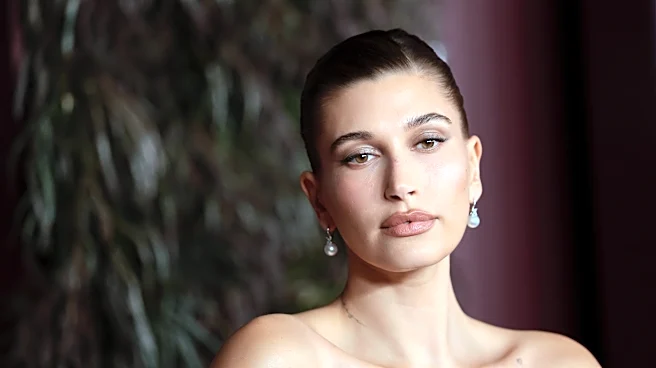
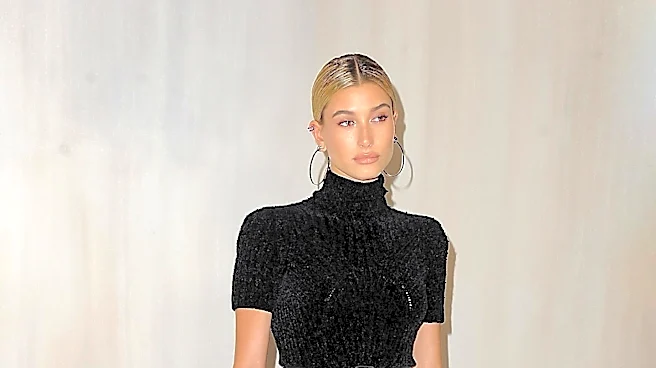
Hailey Bieber, model and entrepreneur, recently faced criticism regarding her business understanding during an interview with financial journalist Andrew Ross Sorkin at The New York Times' 2026 DealBook Summit. Bieber, who founded her skincare company
rhode in 2022, sold it to e.l.f. Beauty in 2025 for up to $1 billion. During the interview, Sorkin questioned her on the valuation of the company and how she could sell a brand so intertwined with her personal identity. Bieber's responses, including her use of the term 'optimistical delusion' to justify the $1 billion valuation, led to online ridicule and further questions about her business knowledge. Despite rhode generating $212 million in revenue within a year of its launch, the interview highlighted ongoing public debate about Bieber's qualifications and the role of her celebrity status and family connections in her success.
Why It's Important?
This event is important as it underscores the ongoing public scrutiny faced by celebrity entrepreneurs, particularly those from privileged backgrounds. Hailey Bieber's experience highlights the challenges of transitioning from a public figure to a respected business leader, where perceived authenticity and business acumen are constantly under evaluation. The sale of rhode for a significant sum, despite public questioning of Bieber's business knowledge, could influence how consumers and investors view celebrity-backed ventures. It also brings to light the double standards often applied to women in business, who may face more intense scrutiny over their qualifications compared to their male counterparts. The discourse around Bieber's interview reflects broader societal conversations about nepotism, privilege, and the definition of success in the modern business landscape.
What's Next?
Following the interview, Hailey Bieber will likely continue to navigate public perception as she remains involved with rhode under e.l.f. Beauty's ownership. The incident may prompt her to more actively demonstrate her business capabilities and strategic involvement in the brand to counter criticisms. For e.l.f. Beauty, integrating rhode and leveraging Bieber's continued influence will be key, while also managing any potential brand perception issues arising from the interview. The broader beauty industry may observe how this situation impacts consumer trust in celebrity-founded brands, potentially leading to a greater emphasis on transparent business practices and demonstrable expertise from celebrity founders. Online discussions about 'nepo babies' and the intersection of fame and business are also expected to persist.
Beyond the Headlines
The scrutiny surrounding Hailey Bieber's business interview delves into deeper societal implications concerning the valuation of celebrity influence versus tangible business expertise. It raises questions about whether a strong personal brand and cultural understanding, as acknowledged by Sorkin, are sufficient to justify significant financial success in the entrepreneurial world. The ethical dimension of 'optimistical delusion' as a business strategy, even if presented colloquially, challenges traditional notions of financial justification and due diligence. Furthermore, the intense online backlash and personal attacks Bieber has faced highlight the often-toxic environment of social media, where public figures are subjected to extreme criticism, regardless of their achievements. This situation also reflects a cultural tension between celebrating self-made success and critiquing inherited privilege, particularly in industries where personal branding plays a crucial role.