





What's Happening?
The Metals Royalty Company Inc. (TMCR), a British Columbia-based critical-minerals royalty company, reported a net income of US$4.48 million (US$0.07 per share) for the third quarter of 2026. This income was primarily driven by a US$21.80 million non-cash
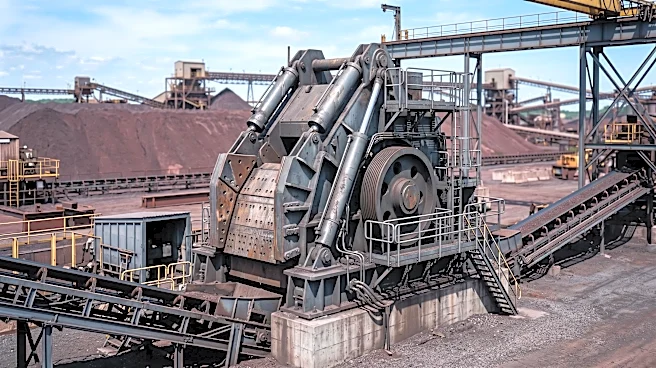
gain on derivatives, which offset operating expenses of US$9.67 million and net finance costs of US$7.65 million. The company remains pre-revenue, with its financial performance largely influenced by accounting-driven gains. Concurrently, the Mesabi Metallics iron ore project in Minnesota, in which TMCR holds a 2.0% royalty interest, is moving into its final commissioning phase. Hot commissioning for crusher circuits, material-handling systems, and dedusting infrastructure is complete, with approximately 1.3 million tonnes of ore stockpiled. Final commissioning is now focused on the beneficiation, balling, induration, and pellet plant areas. First pellet production from Mesabi Metallics is anticipated in Q4 2026, with TMCR expecting its first quarterly royalty payment in Q1 2027. The Export-Import Bank of the United States (EXIM) approved a US$770 million direct loan for the Mesabi mine in September 2026.
Why It's Important?
The progress at the Mesabi Metallics project is significant for the U.S. industrial sector, particularly in steel production. The planned US$15 billion Iowa steel mill, which Mesabi Metallics intends to supply, highlights a strategic move towards strengthening domestic supply chains for critical materials. The EXIM loan approval underscores governmental support for such initiatives, aiming to reduce reliance on foreign sources for essential resources. For The Metals Royalty Company Inc., the Mesabi project represents a near-term revenue opportunity, with royalty payments expected to commence in early 2027. This could provide a stable income stream for the company, diversifying its portfolio beyond longer-duration optionality projects like NORI. The financial health and operational success of projects like Mesabi Metallics are crucial for regional economic development, creating jobs and fostering industrial growth in Minnesota and potentially Iowa. The focus on critical minerals also aligns with broader U.S. policy goals of securing domestic access to resources vital for various advanced technologies and national security.
What's Next?
The Mesabi Metallics project is expected to achieve its first pellet production in Q4 2026, with The Metals Royalty Company Inc. anticipating its initial royalty payment in Q1 2027. This will mark a significant transition for TMCR from a pre-revenue company to one generating cash flow from its royalty interests. The company's valuation will become increasingly sensitive to Mesabi's production ramp-up, long-term direct reduced (DR) pellet pricing, and corporate cost discipline. Meanwhile, the NORI polymetallic nodule project, another key asset for TMCR, is awaiting NOAA certification following the closure of its public comment period. This regulatory milestone is crucial for its progression towards offshore installation and commissioning, targeted for Q4 2027, with first production in 2028. Future developments will include monitoring the operational execution at Mesabi, the sustained pricing of DR pellets, and the progress of NORI's permitting and commercialization milestones, all of which will influence TMCR's financial performance and valuation.
Beyond the Headlines
The advancements in projects like Mesabi Metallics reflect a broader strategic shift in the U.S. towards re-shoring and strengthening domestic critical mineral and industrial supply chains. The substantial EXIM loan for Mesabi highlights a governmental commitment to fostering self-sufficiency in key sectors, potentially mitigating risks associated with global supply chain disruptions and geopolitical tensions. This trend could lead to increased investment in domestic mining and processing capabilities, creating a more resilient industrial base. However, the financial structure of royalty companies like TMCR, with significant non-cash gains and losses from derivatives, also points to the complex financial engineering involved in funding large-scale resource projects. The interplay between accounting-driven profits and actual operational cash flow will be a critical aspect for investors to monitor. Furthermore, the environmental and regulatory processes for projects like NORI, even with their longer-term optionality, underscore the increasing scrutiny and potential delays faced by resource extraction initiatives, balancing economic needs with ecological considerations.