








What's Happening?
PiLogic, a startup specializing in artificial intelligence software for satellite fault prediction, has partnered with the U.S. Air Force Research Laboratory (AFRL) to test its technology. The collaboration, under a two-year Cooperative Research and Development
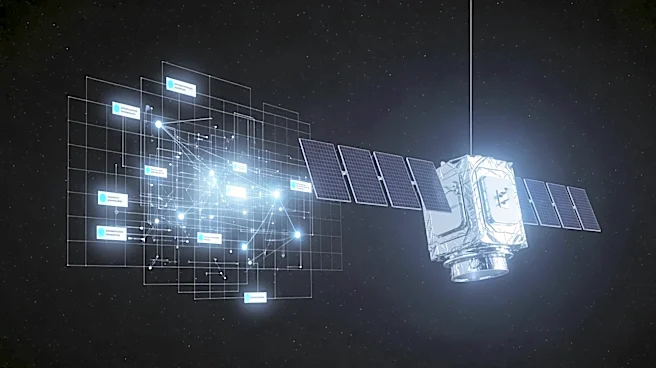
Agreement, aims to improve the detection and diagnosis of satellite issues. PiLogic's software analyzes onboard sensor data to detect anomalies and predict potential failures, offering an alternative to traditional rules-based monitoring systems. The software uses probabilistic reasoning and automated causal analysis to identify the most likely causes of issues, providing engineers with a clearer understanding of spacecraft behavior. This approach is intended to enhance spacecraft autonomy and health monitoring.
Why It's Important?
This partnership is crucial for advancing the use of artificial intelligence in military space operations. By improving the ability to predict and diagnose satellite faults, the collaboration could enhance the reliability and longevity of satellite systems, which are vital for national security and defense. The use of AI in this context addresses the limitations of traditional monitoring systems, which may struggle with complex or ambiguous issues. PiLogic's technology promises to provide more accurate and explainable insights, reducing the risk of mission-threatening failures. This development reflects a broader trend of integrating AI into aerospace and defense applications, highlighting the growing importance of AI in enhancing operational capabilities.
What's Next?
The AFRL will use the project to explore new approaches to spacecraft autonomy and health monitoring. As the partnership progresses, PiLogic may pursue additional opportunities with NASA and the U.S. Space Force. The company has already raised significant funding and is seeking to expand its customer base. The success of this collaboration could lead to further adoption of AI technologies in satellite operations, potentially influencing how military and commercial space missions are conducted. The project also includes government support and sponsorship for security clearances, enabling PiLogic to engage in classified work, which could open new avenues for innovation and collaboration in the defense sector.