



What's Happening?
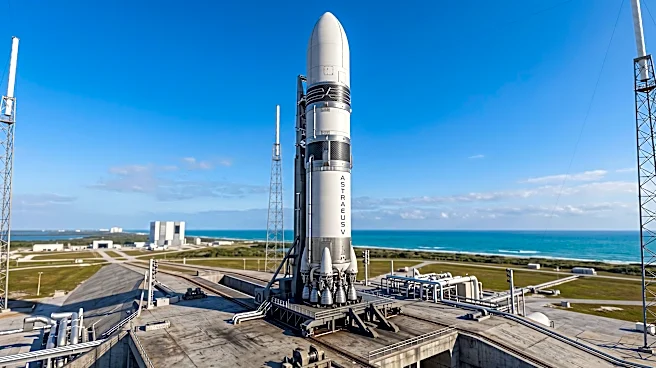
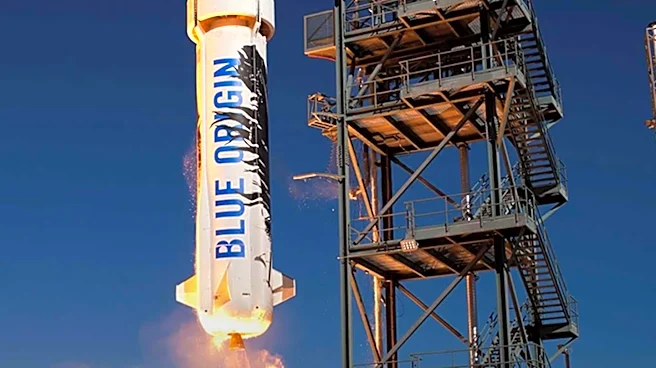
Blue Origin has announced two significant developments for its New Glenn rockets: a new third stage and a new first-stage engine. During an invite-only event at the Kennedy Space Center called Up.Summit, Blue Origin CEO Dave Limp revealed the Glenn Stage
3 (GS3), designed for missions requiring direct injection to geostationary orbit and Earth-escape trajectories. The GS3, powered by the BE-7 engine, is expected to be the first composite liquid hydrogen tank ever flown in space. Additionally, Blue Origin introduced Northstar, a new first-stage engine similar to the BE-4 but capable of producing 715,000 pounds of thrust, an increase from the BE-4's 640,000 pounds. These announcements come as the company continues to work towards the first flight of New Glenn following a pad explosion in late May.
Why It's Important?
These advancements are crucial for Blue Origin's competitive position in the commercial space launch market. The new GS3 upper stage significantly enhances the New Glenn rocket's performance, allowing it to deliver heavier payloads to more distant orbits, including cis-lunar space. This expanded capability could attract more government and commercial contracts, particularly for missions requiring direct injection to geostationary orbit or lunar trajectories. The introduction of the more powerful Northstar engine further boosts the New Glenn's lift capacity and efficiency, potentially reducing launch costs and increasing mission flexibility. These developments are vital for Blue Origin as it aims to establish itself as a major player in space transportation, competing with established entities and other emerging private space companies.
What's Next?
Blue Origin has already secured a government mission for 2028 that will utilize the GS3 to launch a payload to cis-lunar space. Testing for the new upper stage is currently underway at Launch Site One in Texas, with successful pressurization tests of the liquid hydrogen tank. While the company did not provide a specific timeline for the Northstar engine's integration, it stated that the engine would be 'joining BE-4' and would be compatible with the New Glenn 9x4 rockets. The BE-4 engine will continue to play an important role, including on the return-to-flight mission. The successful development and deployment of these new components will be critical for Blue Origin to meet its launch commitments and expand its market share in the increasingly competitive space industry.
Beyond the Headlines
The development of a composite liquid hydrogen tank for the GS3 represents a significant engineering feat, pushing the boundaries of materials science in aerospace. If successful, this could set a new standard for lightweight and efficient fuel containment in space vehicles, influencing future rocket designs across the industry. The continuous iteration and improvement of engine technology, as seen with Northstar, highlight the rapid pace of innovation in the private space sector. This competition drives down costs and increases access to space, democratizing space exploration and utilization. The ability to rapidly develop and test advanced propulsion systems, as demonstrated by Blue Origin, underscores the agility of private companies compared to traditional government-led space programs, potentially accelerating the timeline for ambitious space missions.