




What's Happening?
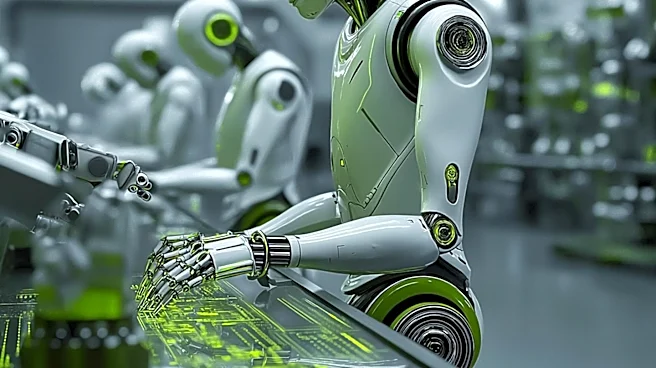
1X has announced the development of new 25 Degree of Freedom (DOF) tendon-driven hands for its NEO humanoid robot platform. These hands are engineered to provide dexterity, strength, safety, and reliability comparable to human capabilities. In addition
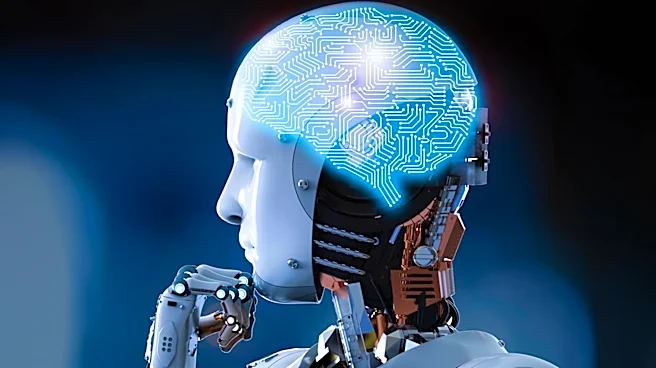
to this hardware advancement, the company has established its World Model Lab, an initiative aimed at expanding the intelligence of its humanoid robots. Concurrently, Sam Sinha has been appointed as the head of world models and a founding researcher for this new lab. These developments signify a concerted effort by 1X to enhance both the physical and cognitive abilities of its humanoid robots, pushing towards more sophisticated and autonomous operation.
Why It's Important?
The introduction of 25-DOF tendon-driven hands represents a significant leap in robotic manipulation, potentially enabling humanoid robots to perform complex tasks requiring fine motor skills and precise object handling. This advancement could have profound implications across various U.S. industries, including manufacturing, logistics, and healthcare, where robots could take on roles currently requiring human-level dexterity. Improved safety features in these hands could also facilitate closer human-robot collaboration in workplaces. The establishment of the World Model Lab underscores a strategic focus on artificial intelligence and machine learning for robotics, which is crucial for developing more adaptable and intelligent robotic systems. This could lead to increased efficiency and productivity, but also raises questions about the future of human labor in tasks that can be automated by such advanced robots.
What's Next?
The immediate next steps for 1X will likely involve integrating these new 25-DOF hands into the NEO humanoid platform and rigorously testing their performance in various real-world scenarios. The World Model Lab, under Sam Sinha's leadership, will focus on developing and scaling the AI models necessary for these robots to understand and interact with their environment more effectively. This will involve extensive research into perception, decision-making, and learning algorithms. Future developments could include demonstrations of the NEO robot performing increasingly complex tasks, potentially leading to wider commercial deployment. The company will also need to address the challenges of mass production and cost-effectiveness to make these advanced humanoid robots accessible to a broader market.
Beyond the Headlines
The advancements by 1X in humanoid robotics, particularly in dexterity and AI, touch upon deeper ethical and societal considerations. As robots approach human-level capabilities, discussions around their integration into society, job displacement, and the nature of human-robot interaction will intensify. The focus on 'near human-level dexterity' and 'world models' suggests a future where robots are not just tools but potentially autonomous agents capable of complex problem-solving. This could lead to new legal frameworks for robotic responsibility and accountability. Furthermore, the development of such sophisticated robotics could spur innovation in related fields like prosthetics and assistive technologies, offering benefits beyond industrial applications. The long-term impact could reshape labor markets, educational requirements, and even our understanding of intelligence and consciousness.