





What's Happening?
Americas Uranium, a Canadian mineral exploration company, has agreed to acquire a 100% interest in the Treeline uranium property located in New Mexico, U.S. The acquisition involves a payment of US$100,000 cash and US$2 million in shares to Verdera Energy
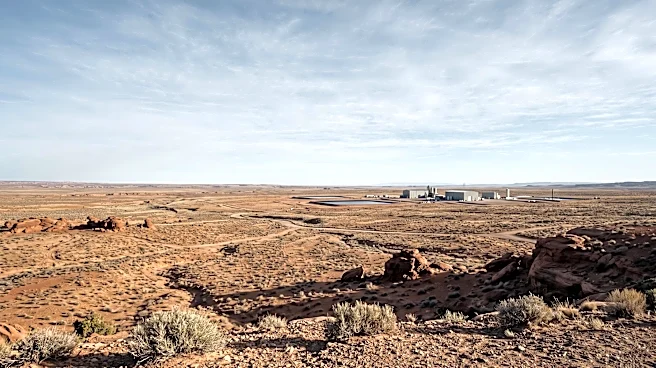
and its subsidiary NM Energy Holding. The Treeline property, situated in an established uranium district across Cibola and McKinley counties, has historical records indicating approximately 1.02 million pounds of uranium oxide. However, this estimate dates back to 1978 and does not meet current National Instrument 43-101 standards for mineral resources. The company plans to advance historical work and conduct drilling to evaluate the estimate under current regulations. Uranium mineralization at Treeline is found in two shallow trends within the Poison Canyon sandstone, with the North trend spanning about 610 meters by 53 meters wide, and the South trend extending 991 meters with widths ranging from 15 to 46 meters. The transaction is pending regulatory approvals, including consent from the Canadian Securities Exchange, and is expected to close within weeks.
Why It's Important?
This acquisition is significant for the U.S. as it aims to expand its domestic nuclear fuel supply chain and increase nuclear generating capacity. U.S. uranium production doubled to 1.4 million pounds of uranium oxide in 2025 from 700,000 pounds in 2024, marking its highest annual level since 2016. The U.S. government has set an ambitious goal to expand nuclear generating capacity from 100 gigawatts in 2024 to 400 gigawatts by 2050. Americas Uranium's CEO, Nicholas Luksha, emphasized that high-quality American uranium assets will become increasingly important as the U.S. strengthens its nuclear power infrastructure. The development of properties like Treeline could contribute to reducing reliance on foreign uranium sources, enhancing energy security, and supporting the growth of the domestic nuclear industry. The move also highlights the increasing investment and exploration activities in the U.S. uranium sector, driven by strategic national energy goals.
What's Next?
Americas Uranium's immediate next steps involve compiling historical drilling data, developing an updated geological model for the Treeline property, and undertaking reverse circulation and diamond drilling. This drilling program is crucial for establishing a National Instrument 43-101-compliant mineral resource estimate, which will provide a more accurate and current assessment of the property's uranium potential. The company will also need to finalize regulatory approvals, including CSE consent, for the transaction to officially close. Following the acquisition, 90% of the share consideration will be issued in staged payments over 36 months. Americas Uranium will grant Verdera a 1.5% royalty, with an option to buy back one-third for US$400,000. The property is also subject to existing 2% net proceeds royalties on uranium and 2% net smelter returns on other minerals held by enCore Energy. The agreement also includes a right of first refusal over additional surrounding properties, potentially allowing for further expansion of Americas Uranium's holdings in the region.
Beyond the Headlines
The acquisition of the Treeline property by Americas Uranium underscores a broader strategic shift in the U.S. energy landscape towards bolstering domestic nuclear capabilities. The push to expand nuclear generating capacity and strengthen the domestic nuclear fuel supply chain has significant implications for national security and energy independence. By increasing domestic uranium production, the U.S. can mitigate geopolitical risks associated with relying on foreign suppliers for a critical energy resource. This trend could also stimulate economic growth in regions with uranium deposits, creating jobs and fostering technological advancements in mining and processing. Furthermore, the emphasis on updating historical estimates to current regulatory standards reflects a commitment to transparency and responsible resource development within the industry. The long-term success of such initiatives will depend on sustained government support, technological innovation, and effective environmental stewardship, as the U.S. navigates the complexities of expanding its nuclear energy footprint.