






What's Happening?
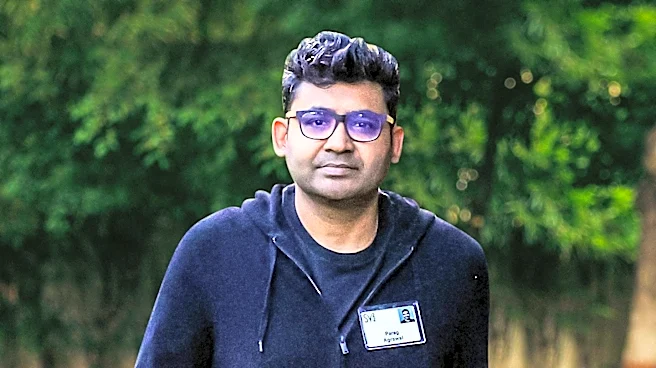
Parag Agrawal, former CEO of Twitter, founded Parallel Web Systems after his departure from the social media company following Elon Musk's takeover. Within two years of its inception, Parallel Web Systems has reportedly achieved a valuation of approximately
₹19,000 crore. The company specializes in developing search infrastructure specifically designed for AI agents. Parallel's approach involves building its web-scale index from scratch, which covers billions of pages. This proprietary index is optimized for large language model reasoning and to enhance the accuracy of AI agents. The company distinguishes its methodology from other existing solutions, such as OpenAI's integrated web search, by emphasizing different architectural choices in retrieval and inference processes.
Why It's Important?
The rapid rise and substantial valuation of Parallel Web Systems highlight a significant shift in the technology landscape, particularly in the realm of artificial intelligence and search infrastructure. Agrawal's venture demonstrates the potential for innovation and rapid growth in specialized AI applications, even for founders who have experienced high-profile exits from major tech companies. This development is crucial for the U.S. tech industry as it signifies a new player in the competitive AI search market, potentially influencing how AI agents access and process information. The focus on a proprietary web-scale index tuned for large language models suggests a move towards more sophisticated and accurate AI-driven search capabilities, which could benefit various sectors relying on advanced data retrieval and AI reasoning. This also underscores the ongoing investment and talent migration towards AI-centric startups.
What's Next?
The continued development and expansion of Parallel Web Systems will likely focus on refining its AI-optimized search infrastructure and potentially attracting further investment. As the company's technology matures, it could challenge existing search paradigms and influence the development of future AI applications that require highly accurate and context-aware information retrieval. Competitors in the AI and search sectors will be closely monitoring Parallel's progress, potentially leading to increased innovation and competition in this space. The success of Parallel Web Systems could also inspire other entrepreneurs to pursue specialized AI solutions, further accelerating the growth of the AI industry.
Beyond the Headlines
The story of Parallel Web Systems extends beyond its financial valuation, offering insights into the resilience and adaptability required in the fast-paced tech industry. Agrawal's ability to pivot from a high-profile leadership role at Twitter to successfully launching a new venture in a cutting-edge field like AI search infrastructure underscores a broader trend of experienced tech leaders channeling their expertise into new, disruptive technologies. This narrative also highlights the increasing importance of specialized, AI-native infrastructure as large language models become more prevalent. The architectural decisions made by Parallel, particularly in building a proprietary web-scale index, suggest a strategic long-term vision for AI's foundational components, moving beyond general-purpose search engines to highly optimized systems for AI reasoning and agent accuracy.