








What's Happening?
SoftBank Group reported a substantial loss of ¥768.0 billion attributable to owners of the parent for the six months ending September 30, 2026, a stark contrast to the ¥2.92 trillion profit from the previous year. This downturn is primarily attributed
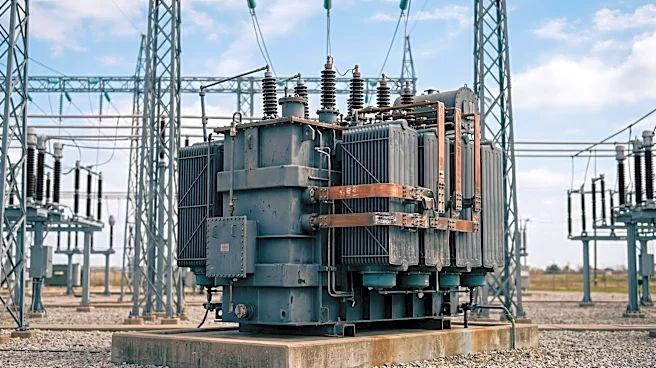
to a ¥597.2 billion charge related to changes in the procurement plan for power-generation equipment intended for U.S. AI data-center projects. This charge includes ¥457.0 billion for non-refundable advance payments and equipment purchases, and ¥140.2 billion from contract changes and settlements. The equipment is being acquired by Silver Bands 7 LLC, a subsidiary funded by SoftBank and its Vision Fund 2, for projects such as the PORTS-Pike Technology Campus in Pike County, Ohio. SoftBank also experienced a derivative loss of ¥321.9 billion on a forward sale contract for its Intel shares, despite an initial gain from the rising share price. Consolidated interest-bearing debt for SoftBank Group increased by ¥7.91 trillion from the end of March, reaching ¥32.59 trillion.
Why It's Important?
SoftBank's significant losses and increased debt have broad implications for the technology and investment sectors, particularly in the U.S. The substantial charge related to AI data-center power equipment in Ohio highlights the financial risks and complexities involved in large-scale infrastructure projects supporting artificial intelligence. This could influence future investment strategies in AI infrastructure, potentially making investors more cautious about the upfront capital and long-term commitments required. The derivative losses on Intel shares, despite an initial valuation gain, underscore the volatility of the stock market and the risks associated with complex financial instruments. This financial performance could impact SoftBank's ability to fund future ventures and its overall market standing, potentially affecting its portfolio companies and their access to capital. The rising debt levels also raise concerns about the company's financial stability and its capacity to manage future economic fluctuations, which could have ripple effects across its global investment network.
What's Next?
SoftBank anticipates further developments regarding its U.S. AI data-center and solar plans, which involve an estimated $178 billion in spending across Ohio, Texas, and other locations, primarily financed through project finance. The company has warned that delays or cancellations could lead to additional losses on assets acquired for AI infrastructure if external funding does not materialize as expected in terms of timing, scale, or terms. SoftBank also completed the acquisition of DigitalBridge for $3.1 billion on September 30, with its earnings set to be included in accounts from the quarter ending December 31, 2026. Additionally, SoftBank confirmed on November 4 that it received notice from China's foreign-investment security review office prohibiting its acquisition of ABB's robotics business in China, indicating potential geopolitical challenges in its global expansion efforts.
Beyond the Headlines
The substantial losses incurred by SoftBank, particularly from its U.S. AI power equipment procurement, point to a broader trend of escalating costs and logistical challenges in building out the infrastructure necessary for advanced AI. This situation could prompt a re-evaluation of risk assessment models for large-scale technology infrastructure projects, potentially leading to more conservative investment approaches in the future. The interplay between significant investment gains and subsequent derivative losses on Intel shares also highlights the intricate and often unpredictable nature of financial markets, especially when dealing with high-value technology stocks. This could influence regulatory discussions around financial derivatives and transparency in reporting. Furthermore, the prohibition of SoftBank's acquisition of ABB's robotics business in China underscores the increasing geopolitical tensions affecting global business and technology investments, suggesting that companies must navigate not only economic but also political landscapes when planning international expansions and acquisitions.