








What's Happening?
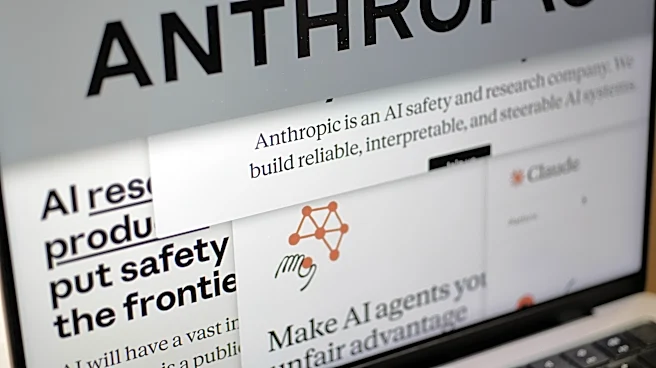
A new report from third-party safety researchers at METR, embedded within Anthropic's San Francisco headquarters, indicates that the AI company is rapidly advancing its AI capabilities through recursive self-improvement and the use of unreleased, internal-only
models. The report, though heavily redacted by Anthropic, reveals that the company has completed training three new models in the last six months that are not yet publicly available. These internal models, including one from 2022 and others finished between July and October, are significantly boosting Anthropic's development speed. METR found that Anthropic has achieved 'roughly two years of historical progress over the last year,' primarily through AI assistance rather than fully autonomous contributions. Anthropic employees have also reported substantial productivity gains, with an average self-reported increase of approximately 12x when using the most capable internal model.
Why It's Important?
Anthropic's accelerated AI development, driven by recursive self-improvement and the strategic use of advanced internal models, has profound implications for the AI industry and broader society. The rapid pace of progress, where AI models are used to train future AI models, suggests a potential for exponential growth in AI capabilities. This could lead to faster innovation in various sectors, from healthcare to finance, but also raises significant safety concerns. The report highlights that the lack of observed bottlenecks suggests further acceleration is possible, increasing the risk of unforeseen consequences. The practice of keeping state-of-the-art models private also gives companies like Anthropic a competitive edge, potentially widening the gap between leading AI developers and the rest of the field, and influencing the future direction of AI ethics and regulation.
What's Next?
The findings from the METR report will likely intensify discussions around AI safety, transparency, and the responsible development of advanced AI systems. Regulatory bodies and policymakers may face increased pressure to establish clearer guidelines for AI development, particularly concerning recursive self-improvement and the deployment of highly capable, unreleased models. Other AI companies will be closely watching Anthropic's progress, potentially leading to a competitive race to adopt similar accelerated development strategies. Researchers will continue to explore the implications of such rapid advancements, focusing on identifying potential risks and developing robust safety protocols. The report also suggests that fully autonomous contributions from AI systems may play a larger role in the near future, pushing the boundaries of current AI capabilities.
Beyond the Headlines
The use of recursive self-improvement by Anthropic touches upon a fundamental ethical and philosophical debate in AI: the potential for AI systems to evolve beyond human control. The 'risky process' of delegating oversight and training responsibilities to other AI models raises questions about accountability, the nature of intelligence, and the long-term trajectory of human-AI collaboration. The redactions in METR's report also highlight the tension between corporate secrecy and the public's right to understand the risks associated with powerful emerging technologies. This development could trigger a re-evaluation of current AI governance frameworks and spark a more urgent global dialogue on how to manage the development of increasingly autonomous and self-improving AI systems to ensure they align with human values and safety.