





What's Happening?
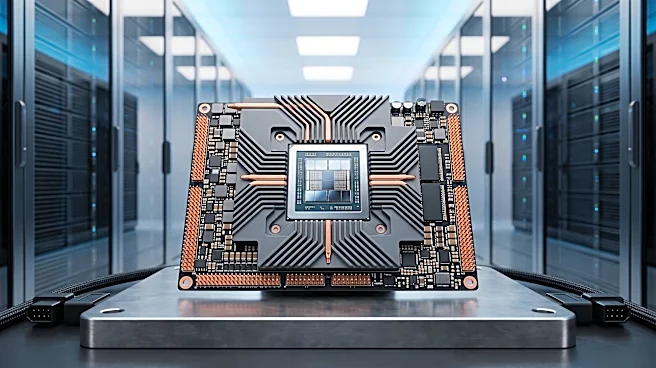
Groq, a company specializing in AI inference infrastructure, has filed a patent for innovative software designed to split large artificial intelligence models across numerous chips. This development addresses the challenge of AI models often being too
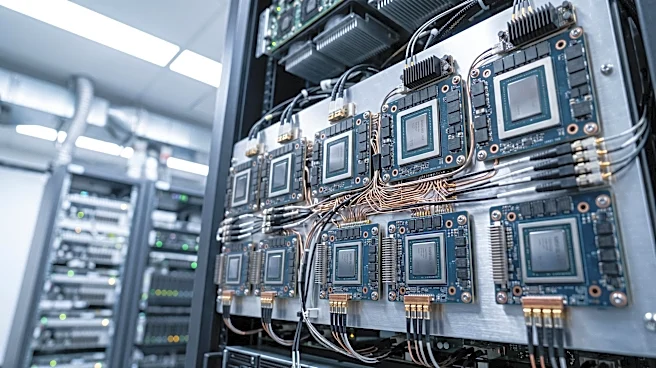
large for the memory capacity of a single chip. The patented software carves up these models in two primary ways: by assigning entire steps of the model to different chips, or by slicing a single, computationally intensive step in half for shared processing between two chips. This method allows chips with smaller local memory to handle complex language models, such as ChatGPT or Llama, with reduced delay and increased throughput. The patent application, US 2026/0367992 A1, is a continuation of a 2023 filing, indicating ongoing development in this area. The examiner's initial review rejected the claims as filed, which is a routine step in the patent process, typically followed by amendments.
Why It's Important?
This patent is crucial for the advancement of AI processing, particularly for companies like Groq that utilize chips with limited individual memory. By enabling the distribution of large AI models across multiple chips, the technology ensures that even the most complex models can run efficiently. This capability is vital for AI services that require low latency and high throughput, such as chatbots, potentially leading to faster response times and lower operational costs for serving AI applications. The approach highlights Groq's hardware philosophy, where software plays a critical role in orchestrating hundreds of chips to function as a single, cohesive machine. This innovation could significantly impact the scalability and accessibility of advanced AI models, making them more practical for widespread deployment in various industries.
What's Next?
The patent application is currently undergoing the standard review process, with an initial rejection of claims being a common occurrence. Groq is expected to respond with amendments to address the examiner's objections, which could lead to the eventual approval of the patent. If granted, this technology could be integrated into Groq's future AI inference infrastructure, potentially enhancing the performance and cost-effectiveness of their B2B SaaS products. The success of this model-slicing software could also influence the broader AI hardware market, encouraging other manufacturers to explore similar distributed processing solutions for large AI models. The ongoing 'AI chip wars' suggest that continuous innovation in chip design and accompanying software will be critical for market leadership.
Beyond the Headlines
The deeper implication of Groq's patent lies in its approach to overcoming hardware limitations through sophisticated software. While the design necessitates a higher chip count due to the smaller memory per chip, the trade-off is predictable speed and performance, which is a significant advantage for real-time AI applications. This strategy contrasts with graphics chips that carry more memory and require less slicing. The reliance on a compiler to plan every operation in advance introduces a challenge: the plan must be flawless, as any miscalculation in memory usage could lead to compilation failure. This highlights a philosophical divide in AI hardware design—between flexible, general-purpose chips and highly optimized, deterministic systems. Groq's commitment to deterministic timing, where every operation is scheduled precisely, underscores a focus on reliability and efficiency for specific AI workloads, potentially setting a new standard for specialized AI accelerators.