





What's Happening?
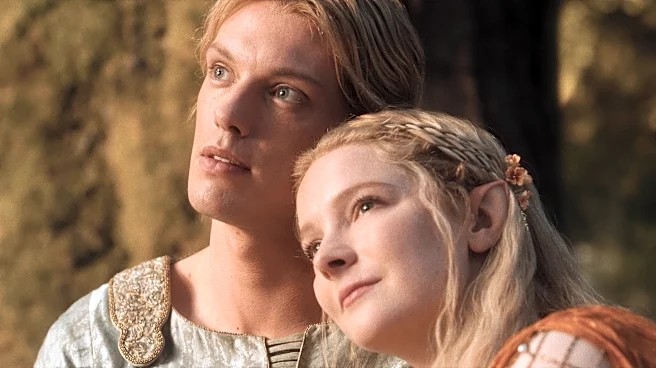
The third season finale of "The Lord of the Rings: The Rings of Power" concluded with a strategic manipulation by Sauron, rather than a direct battle. Despite forging the One Ring earlier in the season, Sauron, portrayed by Charlie Vickers, seemingly
surrenders to Pharazôn’s Númenórean army. This act is a calculated move, directly inspired by J.R.R. Tolkien's writings, where Sauron is taken to Númenor and corrupts the kingdom from within, leading to its eventual downfall. Showrunners J.D. Payne and Patrick McKay emphasized that this ending was chosen to set up a more devious and calculating version of Sauron for the upcoming fourth season. The series has been renewed for a fourth season, with the narrative expected to follow Sauron's infiltration and corruption of Númenor. The finale also featured a confrontation between Sauron and Gandalf, an imagined encounter by the showrunners, where Sauron offers Gandalf control of Middle-earth.
Why It's Important?
This strategic conclusion to Season 3 is significant for several reasons. Firstly, it demonstrates the showrunners' commitment to adapting the deeper lore of Tolkien, particularly Sauron's cunning and manipulative nature, which is a cornerstone of his character in the Second Age. By having Sauron surrender and infiltrate Númenor, the series is poised to explore themes of political corruption, deception, and the slow erosion of a powerful civilization from within, rather than through overt warfare. This narrative direction allows for a more nuanced portrayal of evil and its insidious spread. For fans of the original works, this adherence to canonical events, even if presented with some creative liberties, is crucial for maintaining authenticity. The renewal for a fourth season underscores the continued investment in this high-budget production, indicating a long-term vision for the series and its exploration of Middle-earth's history.
What's Next?
The fourth season of "The Lord of the Rings: The Rings of Power" is expected to focus on Sauron's infiltration and corruption of Númenor. This storyline is a pivotal event in Tolkien's lore, leading to the downfall of the great human kingdom. The showrunners have indicated that the central question for the next season will revolve around the consequences of capturing Sauron and his subsequent actions within Númenor. A key mystery left unresolved in the finale is the fate of the One Ring, as Sauron removes it before his surrender. The showrunners and actor Charlie Vickers are aware of its location within the series' narrative, but its absence from Sauron's person during his surrender will likely play a significant role in future plot developments. The series will delve into how Sauron, in his 'fair' form, manipulates the Númenóreans and brings about their destruction.
Beyond the Headlines
The portrayal of Sauron in "The Rings of Power" challenges preconceptions many viewers might have from Peter Jackson's films, where he is primarily depicted as a glowing eye. The series emphasizes Sauron's ability to appear in a 'fair' and charismatic form, using manipulation and deception as his primary weapons. This interpretation aligns more closely with Tolkien's original descriptions of Sauron during the Second Age, highlighting the psychological and political dimensions of his evil. The show's decision to focus on this aspect of Sauron's character, rather than solely on large-scale battles, offers a deeper exploration of the nature of power and corruption. The 'hot Sauron' memes and online discussions reflect a broader cultural engagement with the character's complex portrayal, demonstrating how modern adaptations can bring new layers of interpretation to classic fantasy villains.