








What's Happening?
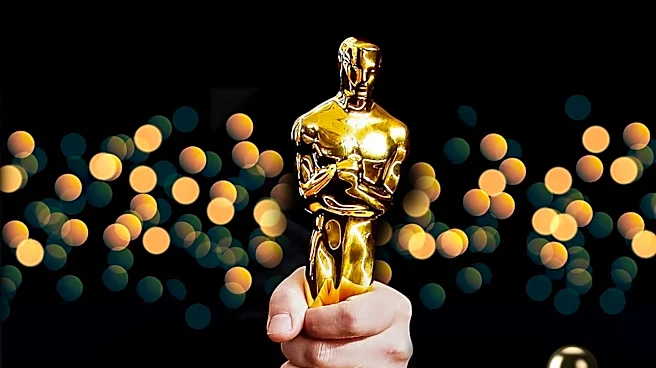
Actor Christopher Lee, known for his role as Saruman in 'The Lord of the Rings' trilogy, expressed strong frustration over the Academy Awards' initial failure to recognize the first two films, 'The Fellowship of the Ring' and 'The Two Towers,' with 'Best
Picture' awards. Speaking to The Guardian, Lee stated that it was a 'disgrace' that these films did not win in their respective years, arguing that they were superior to the movies that ultimately received the awards, such as 'A Beautiful Mind' and 'Chicago.' He firmly believed that Peter Jackson's epic fantasy movies were monumental achievements in filmmaking and deserved the highest accolades. While 'The Return of the King' later swept all 11 of its nominations, including 'Best Picture,' Lee's comments highlight a perceived oversight by the Academy in the earlier years of the trilogy's release.
Why It's Important?
Christopher Lee's outspoken criticism reflects a broader sentiment among fans and critics regarding the Academy Awards' historical tendency to overlook fantasy and genre films in major categories. His comments underscore the debate about what constitutes 'award-worthy' cinema and whether the Academy adequately recognizes groundbreaking achievements outside traditional dramatic fare. The 'Lord of the Rings' trilogy, with its immense scope, innovative special effects, and dedicated fan base, pushed the boundaries of filmmaking. Lee's frustration highlights the perceived disconnect between critical and popular acclaim, and the often-conservative nature of prestigious awards. The eventual triumph of 'The Return of the King' validated the trilogy's artistic merit, but the initial snubs for its predecessors fueled discussions about the criteria and biases influencing Oscar nominations and wins, impacting how future large-scale fantasy productions are viewed by the industry.
What's Next?
The legacy of Christopher Lee's comments and the 'Lord of the Rings' Oscar journey continues to influence discussions around genre films and awards recognition. As more high-budget fantasy and science fiction productions gain critical and commercial success, the Academy faces ongoing pressure to evolve its perspectives on what constitutes cinematic excellence. Future awards seasons will likely see continued debate over whether genre films receive their due recognition in major categories, or if they remain largely confined to technical awards. Lee's advocacy for the trilogy serves as a reminder of the passion and conviction artists hold for their work and the importance of acknowledging diverse forms of storytelling. This ongoing conversation will shape how future generations of filmmakers approach ambitious genre projects and how awards bodies adapt to changing cinematic landscapes.
Beyond the Headlines
Christopher Lee's remarks delve into the deeper cultural perception of fantasy as a legitimate art form. For many years, fantasy literature and film were often relegated to a niche status, seen as less 'serious' than other genres. Lee's strong defense of 'The Lord of the Rings' as a monumental cinematic achievement challenged this perception, advocating for the artistic and technical merits of a genre that often requires immense creativity and innovation. His comments also touch upon the subjective nature of artistic judgment and the inherent biases that can exist within established institutions like the Academy. The eventual sweep by 'The Return of the King' can be seen as a turning point, signaling a greater acceptance of epic fantasy within mainstream critical circles, but the initial resistance highlights the cultural hurdles that genre works often face in gaining widespread critical validation, influencing how such films are produced, marketed, and received.