


What's Happening?
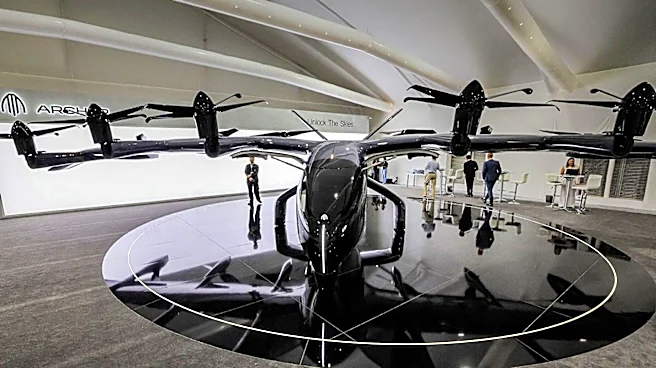
Archer Aviation has announced the launch of two new autonomous hybrid vertical takeoff and landing (VTOL) aircraft, named Halo and Thunder, at the Farnborough Airshow. Halo is designed for commercial applications, while Thunder is intended for military
missions. The company, known for its Midnight electric VTOL air taxi, plans to leverage technologies developed for Midnight in these new programs. Archer's Chief Technology Officer, Tom Muniz, emphasized the potential of a significant dual-use market for these aircraft, which combine a turbogenerator for cruise power with batteries for high-power flight phases. The defense market is seen as a faster path to deployment due to fewer certification hurdles compared to civil passenger aircraft.
Why It's Important?
The introduction of these hybrid VTOL aircraft by Archer Aviation signifies a strategic expansion into both commercial and military markets, potentially transforming the landscape of urban air mobility and defense logistics. The dual-use nature of these aircraft could lead to significant advancements in both sectors, offering new capabilities for urban transportation and military operations. The defense market's quicker deployment timeline could allow Archer to refine its technologies before broader commercial application, potentially positioning the company as a leader in the emerging VTOL market. This move also highlights the growing interest and investment in advanced air mobility solutions.
What's Next?
Archer Aviation will continue to develop and test these aircraft, with a focus on achieving regulatory approval and public acceptance for widespread autonomous operations in civilian airspace. The company is also working on a generative artificial intelligence model, Zee, to support the coordination of large fleets of autonomous aircraft. As the defense market offers a quicker path to deployment, Archer may prioritize military applications initially, while preparing for eventual commercial expansion. The success of these programs could influence future regulatory frameworks and public perception of autonomous air mobility.