





What's Happening?
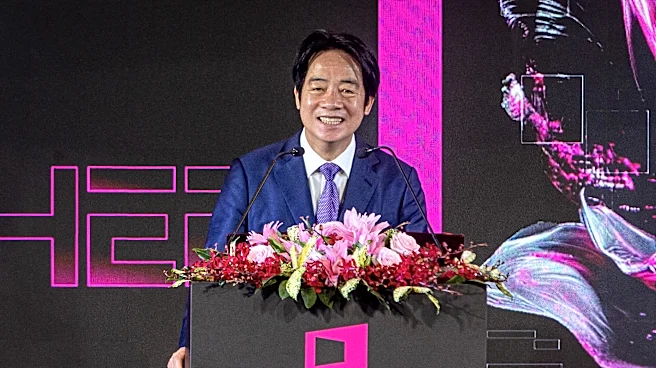
President Lai Ching-te of Taiwan met with Idaho Governor Brad Little, highlighting the strong trade and economic ties between Taiwan and Idaho. President Lai thanked Governor Little for Idaho's consistent support for Taiwan and its efforts in promoting
bilateral exchanges. This marks Governor Little's fourth visit to Taiwan as governor, underscoring the importance he places on strengthening relations. President Lai expressed optimism for deeper cooperation in key sectors such as semiconductors, electronics, and advanced manufacturing, aiming to build more resilient global supply chains. He also advocated for the swift signing of an avoidance of double taxation agreement between Taiwan and the United States to create a more favorable investment environment for businesses on both sides. Taiwan was Idaho’s second-largest global trading partner for the ninth consecutive year, with a strong foundation in high-tech and electronics industries.
Why It's Important?
The meeting between President Lai and Governor Little underscores the critical role of sub-national diplomacy in strengthening U.S.-Taiwan relations, particularly in strategic economic sectors. Idaho's consistent support for Taiwan, coupled with significant trade ties in semiconductors and electronics, is vital for Taiwan's international standing amidst increasing pressure from China. For the U.S., these state-level engagements reinforce its unofficial relationship with Taiwan and contribute to the resilience of global supply chains, especially in the crucial semiconductor industry. The call for an avoidance of double taxation agreement is significant for U.S. businesses, as it would reduce financial burdens and incentivize further investment in Taiwan, thereby deepening economic integration and mutual prosperity. This collaboration helps to diversify supply chains away from over-reliance on mainland China, aligning with broader U.S. strategic goals of economic security and technological leadership. The continued partnership also serves as a counter-narrative to China's efforts to isolate Taiwan, demonstrating ongoing international support.
What's Next?
The visit is expected to foster continued collaboration between Taiwan and Idaho, particularly in the high-tech and advanced manufacturing sectors. Governor Little will witness the signing of a memorandum of understanding on education, aiming to expand exchanges in education and talent cultivation, including university collaboration and research connections. This initiative will further strengthen the human capital pipeline essential for the semiconductor and electronics industries. The push for an avoidance of double taxation agreement between Taiwan and the United States will likely gain momentum, with both sides recognizing its potential to enhance investment and trade. Such an agreement would streamline financial operations for companies like Micron, which has a significant presence in Taiwan. These ongoing efforts are crucial for building more resilient global supply chains and reinforcing Taiwan's position as a key player in the global technology landscape, while also solidifying U.S.-Taiwan economic ties.
Beyond the Headlines
The emphasis on semiconductor cooperation between Taiwan and Idaho, exemplified by Micron's operations in Taiwan, highlights a deeper strategic imperative beyond mere economic exchange. It reflects a global recognition of Taiwan's indispensable role in the advanced technology ecosystem, particularly in an era defined by artificial intelligence. This collaboration is not just about trade; it's about securing critical technological infrastructure and fostering innovation that has far-reaching implications for national security and economic competitiveness. The educational and talent cultivation initiatives are crucial for sustaining this technological edge, ensuring a continuous flow of skilled professionals. Furthermore, these sub-national partnerships serve as a model for how democratic nations can build robust, resilient alliances that circumvent geopolitical pressures, demonstrating that economic and technological interdependence can be a powerful tool for diplomatic influence and stability in a complex international environment.