







What's Happening?
Alamos Gold Inc. announced its third-quarter 2026 financial and operational results, reporting gold production of 119,000 ounces, which aligns with quarterly guidance. The company achieved record performance from its Island Gold District, offsetting lower-than-planned
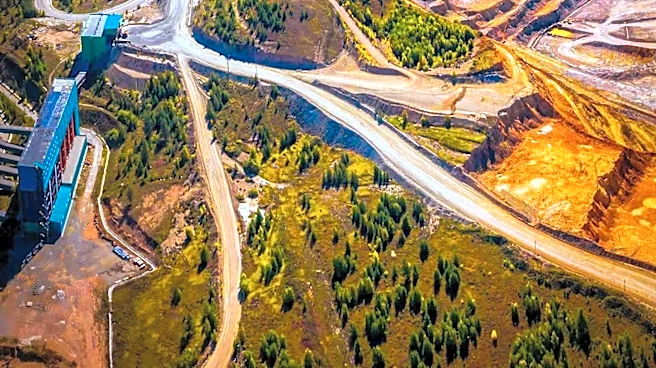
production from Young-Davidson. Revenues for the quarter reached $510.4 million, a 10% increase from the prior year, driven by higher realized gold prices. However, net earnings decreased to $165.6 million from $276.3 million in Q3 2025, primarily due to a one-time impairment reversal in the previous year. All-in sustaining costs (AISC) rose to $1,956 per ounce, an increase from the second quarter, attributed to lower production at Young-Davidson and higher sustaining capital at the Island Gold District. The company also noted delays in the commissioning of the Island Gold District's shaft expansion and lower underground development rates at the PDA project, pushing completion timelines into mid-2027.
Why It's Important?
Alamos Gold's performance reflects the dynamic challenges and opportunities within the gold mining sector. The increase in realized gold prices positively impacted revenue, highlighting the sensitivity of mining companies to commodity market fluctuations. However, rising AISC indicates inflationary pressures and operational complexities, which can compress profit margins. The delays in key growth projects, such as the Island Gold District's shaft expansion and the PDA mill, are significant. These projects are crucial for the company's long-term strategy to nearly double its annual production to one million ounces by 2030 at substantially lower costs. Any setbacks in these developments could impact future production targets, cost efficiencies, and overall shareholder value, potentially affecting investor confidence and the company's competitive position in the U.S. and global gold markets.
What's Next?
Alamos Gold anticipates an increase in production and a decrease in costs during the fourth quarter of 2026, driven by further growth from the Island Gold District. The company remains on track to meet its revised full-year production and cost guidance. Despite the short-term delays in the Island Gold District and PDA projects, the company asserts that these will not impact its medium to longer-term outlook of achieving approximately one million ounces annually by 2030. The company plans to continue its share buyback program, having repurchased 549,757 shares for $16.6 million subsequent to the quarter-end. Additionally, Alamos Gold has eliminated most of its legacy gold hedges, providing further upside exposure to higher gold prices in 2027. Updates on future mining rates and costs for Young-Davidson and PDA are expected in early 2027 with the release of the company's updated three-year guidance.
Beyond the Headlines
The mixed results from Alamos Gold underscore broader trends in the mining industry, where companies balance ambitious growth projects with operational realities and market volatility. The increase in AISC, despite higher gold prices, points to persistent inflationary pressures on labor, energy (diesel prices tied to the Middle East conflict), and equipment, which are critical considerations for all resource extraction companies. The strategic decision to eliminate legacy gold hedges indicates a bullish outlook on future gold prices, positioning the company to benefit from potential market upturns. Furthermore, the company's continued investment in exploration and development, alongside its commitment to sustainable practices and community engagement, highlights the evolving expectations for corporate responsibility within the mining sector. These factors collectively shape the long-term viability and social license to operate for mining companies.