




What's Happening?
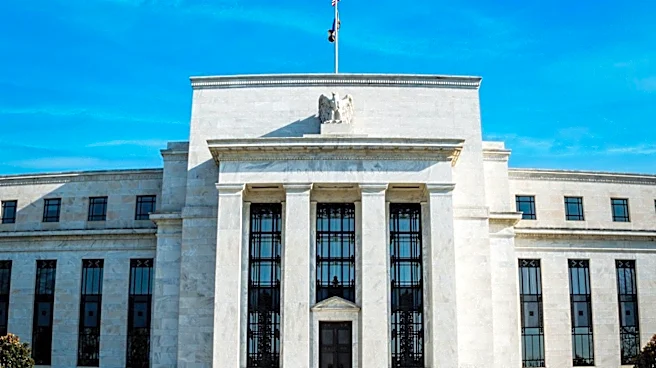
Austan Goolsbee, President of the Federal Reserve Bank of Chicago, has articulated his approach to monetary policy communication, prioritizing the Federal Reserve's credibility over making specific predictions about future interest rate paths. During
a media roundtable, Goolsbee stated his comfort with avoiding explicit forward guidance on rate hikes before new data becomes available. He highlighted that inflation is no longer solely driven by tariff and oil shocks but is now also influenced by overheating demand, particularly from the AI data-center investment boom and AI-related wealth. Goolsbee expressed concern over persistent inflation, noting that recent months have shown 'borderline disturbingly high inflation rates' with little progress in key sectors. He emphasized that the steepness of future rate adjustments will depend on whether inflation is demonstrably heading back to the 2% target, a trend he currently does not observe. He also noted that while consumer sentiment on inflation aligns with the data, their gloom about the real economy has decoupled from their spending habits, leading him to place less weight on sentiment as a forecasting tool.
Why It's Important?
Goolsbee's stance on communication and inflation has significant implications for U.S. financial markets and economic policy. His reluctance to provide explicit forward guidance aims to preserve the Fed's credibility, a lesson drawn from past crises, suggesting a more data-dependent and less prescriptive approach to monetary policy. This could lead to increased market volatility as investors may have less certainty about future rate decisions. The identification of AI-driven investment and wealth as new contributors to demand-side inflation indicates a broadening of inflationary pressures beyond traditional supply shocks. This suggests that the Fed may need to consider a wider range of economic factors when formulating policy, potentially leading to more aggressive or sustained tightening measures if these new sources of demand continue to fuel inflation. The decoupling of consumer sentiment from spending also challenges conventional economic forecasting models, implying that traditional indicators of economic health may be less reliable in the current environment.
What's Next?
As Goolsbee prepares to become a voting member of the Federal Open Market Committee (FOMC) in January, his views will directly influence future monetary policy decisions. His emphasis on inflation not currently being on a path back to 2% suggests a potential for continued or even steeper rate hikes. The Fed will likely continue to closely monitor services inflation, which Goolsbee views as a critical indicator of overall economic overheating, and the financial stability implications of the AI investment boom, particularly the transparency of its financing. Businesses and consumers should anticipate that the Fed's actions will remain highly responsive to incoming economic data, especially inflation figures, rather than pre-announced policy paths. The ongoing assessment of how AI-related investments and wealth impact demand will be crucial in shaping the Fed's strategy to achieve its inflation target.
Beyond the Headlines
Goolsbee's concerns about the opacity of financing in the AI data-center buildout and the potential for 'hidden losses' echo past financial stability risks, such as those seen in the 1990s internet boom. This highlights a deeper systemic risk that could emerge if the rapid growth in the AI sector is not transparently managed, potentially leading to unforeseen vulnerabilities in the broader financial system. The observation that 'nobody hides good news' implies a cautious approach to areas lacking transparency, suggesting that regulators may increase scrutiny on the financing structures within the burgeoning AI industry. Furthermore, the divergence between consumer sentiment and actual spending behavior raises questions about the psychological and behavioral aspects of economic decision-making in an inflationary environment, potentially prompting a re-evaluation of how economic sentiment is measured and interpreted by policymakers.