






What's Happening?
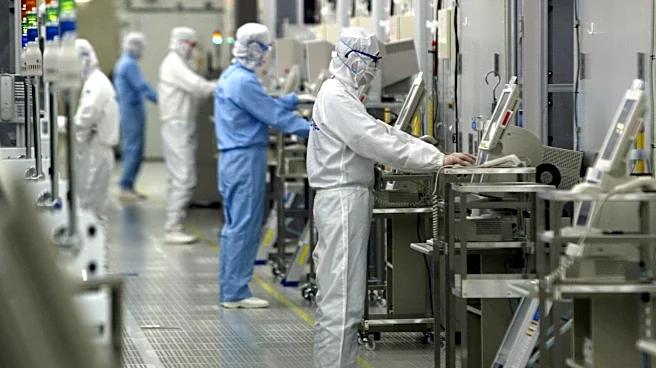
Applied Materials CEO Gary Dickerson stated that the demand for advanced semiconductors continues to exceed supply, necessitating multiyear investments in new fabrication capacity to bridge this gap. According to Dickerson, customers are actively pressing
the company to deliver equipment sooner. Applied Materials reported better-than-expected quarterly results, with customers rapidly constructing new manufacturing plants due to record semiconductor demand. The company anticipates 2027 to be another record year for both Applied Materials and the broader market, with wafer fab equipment demand projected to increase by over 30% year-over-year. The pace of this growth is contingent on the semiconductor supply chain's ability to expand sufficiently. Applied Materials' Q4 sales rose 53% to $10.41 billion, surpassing analysts' expectations of $10.30 billion, and adjusted profit reached $4.16 per share, exceeding expectations of $4.06.
Why It's Important?
The persistent imbalance between the supply and demand for advanced semiconductors, as highlighted by Applied Materials, underscores a critical challenge for numerous U.S. industries reliant on these components. This includes sectors like technology, automotive, and defense, which depend on a stable and sufficient supply of chips for innovation and production. The call for multiyear investments in fabrication capacity indicates that the current supply chain constraints are not short-term issues but structural problems requiring significant capital expenditure and strategic planning. For U.S. businesses, this could mean continued elevated costs for components, potential production delays, and a need to diversify supply chains or invest in domestic manufacturing capabilities. Companies like Applied Materials, which provide the equipment for chip manufacturing, stand to gain from increased investment in new fabs, while industries that consume these chips face the challenge of securing supply and managing costs.
What's Next?
Applied Materials expects fiscal first-quarter adjusted EPS of $4.35, plus or minus $0.20, on revenue of $11.10 billion, plus or minus $500 million, exceeding analysts' expectations. The company's outlook suggests continued strong demand for chipmaking equipment. The semiconductor industry will likely see ongoing efforts to expand manufacturing capacity, with a focus on accelerating the delivery of essential tools. The pace of growth in wafer fab equipment demand, projected to rise over 30% year-over-year by 2027, will depend on the semiconductor supply chain's ability to scale up. This will involve significant investments in new fabrication plants and potentially new technologies to improve efficiency and output. The market will closely watch for signs of supply chain expansion and how quickly the industry can close the supply-demand gap.
Beyond the Headlines
The sustained demand for advanced semiconductors and the need for multiyear investments in fabrication capacity point to a fundamental shift in the global technology landscape. This situation highlights the strategic importance of semiconductor manufacturing, not just for economic competitiveness but also for national security. Governments, including the U.S., are increasingly recognizing this and implementing policies, such as the CHIPS and Science Act, to bolster domestic chip production. The emphasis on accelerating equipment delivery and expanding the supply chain could lead to increased automation and technological advancements in manufacturing processes. Furthermore, the tight supply could spur innovation in chip design, pushing for more efficient and specialized semiconductors that can maximize available capacity. The long-term implications include a potential restructuring of global supply chains, with a greater focus on regional self-sufficiency and resilience.