



What's Happening?
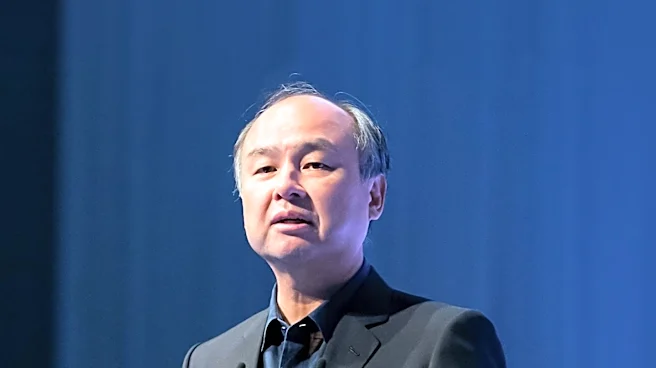
SoftBank Group CEO Masayoshi Son reportedly explored financing for a potential acquisition of SK Hynix, a major memory chip supplier, with Wall Street financial institutions. The reported transaction was valued at approximately $1 trillion. However, SoftBank has
stated that the idea is no longer under active consideration, and SK Hynix has denied any knowledge of such discussions. The report, initially from The Information, did not indicate a formal offer, signed term sheet, or financing commitment. The exploration highlights the increasing strategic value of memory capacity, particularly high-bandwidth memory (HBM), which is crucial for artificial intelligence (AI) hardware. SK Hynix emphasized that any foreign acquisition would require prior government approval under South Korean law, adding a significant regulatory hurdle to any potential deal.
Why It's Important?
This reported exploration underscores the intense competition and strategic importance of memory chip suppliers in the global technology landscape, especially with the surging demand for AI hardware. SK Hynix's role as a central memory chip supplier, particularly in AI memory, makes it a highly valuable asset. A potential $1 trillion acquisition, even if exploratory, signals the perceived value of controlling critical components for AI infrastructure. For the U.S. technology sector, a shift in ownership or control of a major memory producer like SK Hynix could impact supply chains, pricing, and competitive dynamics for AI hardware and other electronic devices. The South Korean government's requirement for prior approval for foreign acquisitions also highlights national security and economic sovereignty concerns surrounding key technology assets, which could influence future international mergers and acquisitions in the semiconductor industry.
What's Next?
Given SoftBank's statement that the idea is no longer under active consideration and SK Hynix's denial of involvement, a near-term acquisition of SK Hynix by SoftBank appears unlikely. However, the report may prompt increased scrutiny from South Korean officials regarding foreign interest in domestic chipmakers, potentially raising the political temperature around memory assets. The underlying market dynamics, characterized by tight memory supply and high demand from AI, are expected to continue. This could lead to sustained upward pressure on RAM prices through the first half of next year, affecting PC builders and hardware buyers. Instead of mega-acquisitions, the industry might see more smaller strategic memory deals, such as supply agreements, partnerships, or minority stakes, which are generally easier to finance and approve.
Beyond the Headlines
The reported $1 trillion figure, while unconfirmed as a concrete offer, reflects a broader trend where the AI buildout has made enormous financial figures seem ordinary, potentially leading to an overestimation of the feasibility of such large-scale transactions. This event highlights the critical shift of memory from a commodity to a strategic chokepoint in the AI hardware race. The concentration of advanced memory production among a few large producers means that any disruption or change in ownership can have far-reaching implications across the entire technology industry. The South Korean government's regulatory stance on foreign acquisitions of key technology companies also sets a precedent for how nations might protect their strategic industries in an era of intense technological competition and geopolitical considerations.